





Islamic authors of the time often cited the number of baths a city had to assess its importance. It is therefore logical that Córdoba, which was for a long time the most important city and political capital of Al-Andalus, had more baths than other Andalusi cities. Thus, in the time of Caliph Abd al-Rahman III (912–961), according to the chronicler al-Maqqari, there were around three hundred, and during the era of Almanzor (976–1002), that number doubled. A preserved text, the manuscript of Tamagrut, gives for the last quarter of the 11th century the perhaps exaggerated figure of 3,701 baths, and 711 in the 12th century.
When studying Islamic baths, historians usually distinguish between emirate, caliphal, Almoravid, Almohad, Nasrid, or even Mudejar baths, such as those built by the master builder Maese Mohamed for King Alfonso XI in the Christian Alcázar.
The preserved Arab baths in Córdoba
The chronology of the five best-preserved Arab baths in Córdoba spans from the 10th to the 14th century. The first and most important of them, the one in question, is located in the Campo Santo de los Mártires square, from the caliphal period, ordered to be built by al-Hakam II (961–976), and forming part of the Andalusi Alcázar of Córdoba. This bath remained in use after the fall of the caliphate, undergoing major renovations that altered its original form during the Almoravid (1086–1147) and Almohad (1147–1213) periods.
As its name suggests, this Arab bath was once part of the Caliphal Alcázar and possibly, as Miguel Muñoz Vázquez tells us, served as the Caliph’s harem. However, no inscriptions from Arab chroniclers have survived to tell us the details of the building’s life.
We know that the Caliphal Alcázar consisted of four large pavilions. One of them, the closest to the Mosque, which once served as the Caliph’s residence, was donated by Ferdinand III the Saint to the Bishop of Córdoba in 1238. The remaining three pavilions were kept by the monarch, and the baths continued to be used for almost another century.
In 1328, King Alfonso XI, who had a bath built for his favorite Doña Leonor de Guzmán in the new Christian Alcázar—the one we know today—buried the Caliphal Baths to create a large parade ground in their place. This area became known as the “Campillo del Rey“. This name remained in use until 1588, when Don Ambrosio de Morales erected a monument in honor of the Christian martyrs murdered by Muslims.
Discovery and enhancement
In 1691, while digging trenches to lay the foundation for a building in the Campo Santo de los Mártires, the remains of the Caliphal Baths were uncovered, three centuries later. At that time, the nearby Church of San Pedro de Alcántara was being built, funded gradually through citizen donations. The director of the works, Fray Juan de la Encarnación, requested permission from the chapter to extract the necessary stones from the Muslim site to speed up construction, due to slow funding. We don’t know the chapter’s decision, but we do know about the piece that interested Fray Juan de la Encarnación—the vault that covered one of the rooms—which has not survived.
With the arrival of the 20th century, a series of ongoing excavations began on the building and its surroundings, with different purposes and varying results. In 1903, during municipal landscaping works, remains of the bath were found, and the investigation was entrusted to Don Rafael Ramírez de Arellano. Arellano identified several chambers, drew a plan of them, discovered and analyzed several decorative remains, and dated them to the time of Caliph al-Hakam II.
The baths were once again covered until 1961, when an excavation campaign aimed at finding funerary remains from the caliphal period brought the building to light again. This time, the excavation was led by Don Félix Hernández and Don Rafael Castejón, who found the remains unearthed by Don Rafael Ramírez de Arellano in the previous excavation, but also uncovered more structures, ceramic remains, and plasterwork. The study was more detailed and thorough, eventually leading, a few years later under Don Félix’s direction, to the site’s declaration as a Site of Cultural Interest.
Due to the difficulty of making the building accessible and understandable from a tourist point of view, a musealization plan was developed to help visitors understand not only the structure of the building but also its importance within the Islamic world. Since October 2006, it has been open to the public under the scheme presented in the “The Rooms” section of this same page.
The museum rooms
Room I: Lobby
We begin our museum visit in the Entrance Lobby, where we will be welcomed and given a brief historical introduction to the site, through explanatory panels and models of the city during the caliphal period. From this point, we will begin to understand the importance of the bath in the Islamic world, as well as its evolution over the years. And what better example than this exceptional bath, which once belonged to the city’s Caliphal Alcázar.
Room II: Audio-Visual
Our second stop is the Audiovisual Room, where we will enjoy a short projection that complements the information received in the museum lobby. The video lasts just over five minutes and addresses the importance of the bath in the Muslim world, its origins and evolution. Special mention is made of the need to preserve this type of building, so it can be appreciated in the future, as is the case here.
Room III: The Andalusi Bath
After the screening, we will move to a small room introducing us to the world of the Andalusi Bath. One of the most important aspects of the bath was its purification ritual, where prayers were said while washing different parts of the body. Moreover, the bath was not only beneficial for bodily hygiene, but also for mental health, as it was a place of leisure and social interaction. This is evident in its architecture—enclosed and isolated from the outside world.
Room IV: The Caliphal Bath
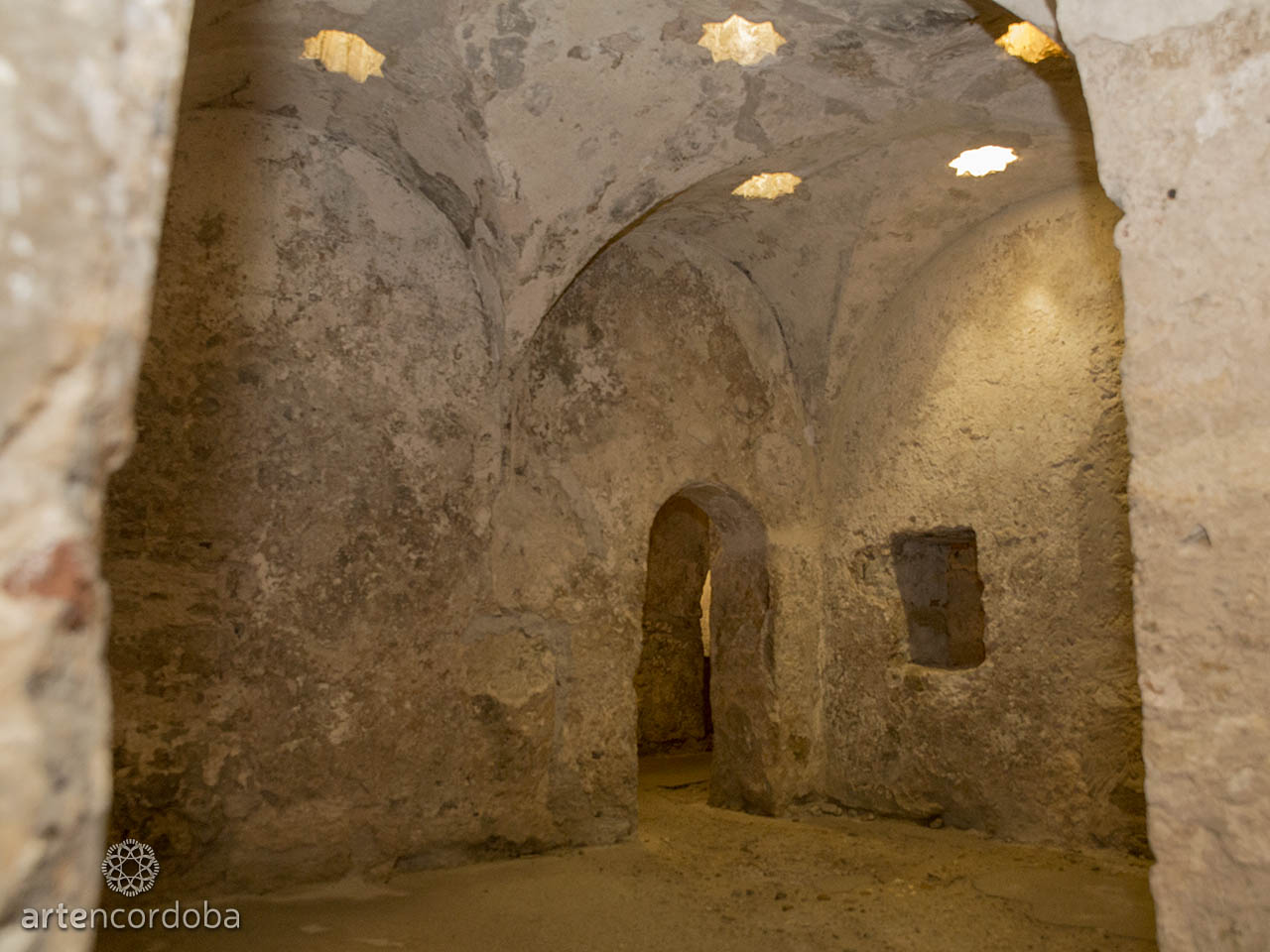
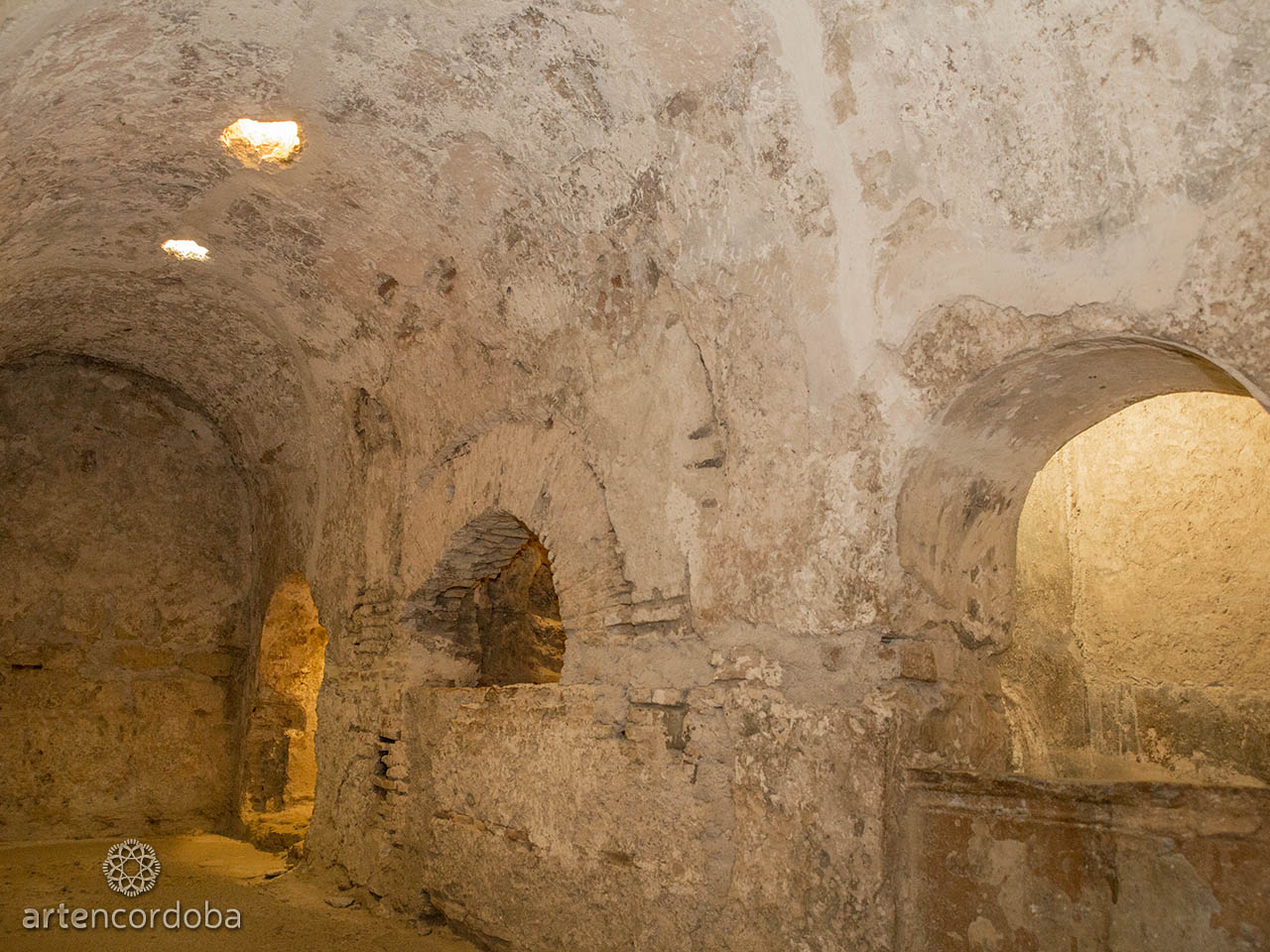
In the following rooms, we learn how the Bath during the Caliphal Era was structured. We explore its layout, its different sections, and the purification and hygiene ritual performed through its rooms. As seen on the plan, the area consists of three large rooms: cold water, warm water, and hot water rooms, in that order. The largest and most decorated was the warm room—a meeting and relaxation space. The last room was the hot water room.
Room V: The Andalusi Garden
After touring the different areas of the caliphal bath, we return to the entrance lobby to visit the rooms in the western wing of the museum. We then enter the room dedicated to the Andalusi Garden, presided over by a large panel showing an exceptional reconstruction of a Taifa-period garden. The Andalusi garden aimed to reflect the idea of paradise, typically featuring a large fountain at its center. Elements such as hydraulic engineering and irrigation-based agriculture were greatly advanced during this period.
Room VI: The Taifa Bath
The next room aims to show us the architectural evolution of baths during the Taifa period, represented in the so-called Reception Hall. The main construction features, possible decorations of the space, and its political functionality are presented through entertaining light and sound narrations. Of special interest is the model in the center of the room, which recreates in detail the bath we are visiting.
Room VII: The Almohad Bath
In this penultimate section of our visit, we explore the last major expansion of the bath, which occurred during the Almohad period. It is located next to the old caliphal bath and the aforementioned reception hall. Next to the old caliphal oven is the hot water room, covered by a barrel vault pierced with star-shaped skylights. An audio narration takes us to the moment when King Alfonso IX, supposedly seated in the warm room, asked the master builder Mohamed to construct some baths in the Christian Alcázar.
Room VIII: Boiler, Furnace, and Service Area
We reach the final stop of our visit, where we see the section responsible for generating the heat and hot water needed for the proper operation and maintenance of the baths. Explanatory panels and audio narrations simulating heat and fire in the boiler explain the mechanisms used and how the area was divided. Everything was designed to ensure that the temperature of the various rooms remained constant.
Tourist Information
Address
Plaza Campo Santo de los Mártires s/n. 14004. Córdoba.
Contact
Tel +34 957 42 01 51 / +34 957 76 02 69 / FAX: +34 957 20 43 33.
Bus routes
- The bus routes with stops nearby are lines 3 and 12.
Opening Hours
Winter Schedule (from September 16 to June 15):
- Tuesday to Saturday: 8:30 a.m. to 7:30 p.m.
- Sundays and Public Holidays: 9:30 a.m. to 2:30 p.m.
Summer Schedule (from June 16 to September 15):
- Tuesday to Saturday: 8:30 a.m. to 3:00 p.m.
- Sundays and Public Holidays: 8:30 a.m. to 2:30 p.m.
Price
- Adults: €3.
- Students: €1.50.
- Children from 0 to 13 years old: Free.
How to Get There
Located about 100 meters from the Mezquita-Catedral, the Caliphal Alcázar Baths are a must-visit to understand the long history of our city. They are situated next to one of the city’s busiest roads, Paseo de la Ribera, so named because it runs alongside the Guadalquivir River as it passes through Córdoba.
If you wish to visit the Arab Baths of the Caliphal Alcázar, also known as the Caliphal Baths, do not hesitate to book one of our guided tours. We are experts in interpreting Córdoba’s historical heritage. We will advise you on tickets, opening hours, prices, how to get there… If you’ve chosen to do tourism in Córdoba, choose a quality option—choose ArtenCórdoba.
Image Gallery