


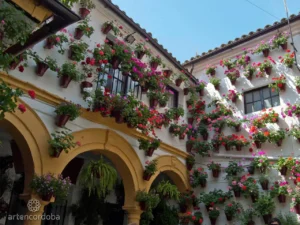




The neighborhood of Alcázar Viejo is also known as San Basilio, in reference to the co-patron saint of the parish of Our Lady of Peace, located in the very heart of the area.
Its history dates back to the first years after the reconquest of the city in 1236, by Ferdinand III the Saint. At the beginning of the 15th century, the area suffered from severe depopulation, so the city council planned to repopulate it by relocating crossbowmen soldiers and their families, thereby strengthening the defensive line of the walled perimeter.
Urbanism and Layout of the Neighborhood
The council’s project also included an extensive urban reorganization program. The Alcázar Viejo neighborhood consists of three main parallel streets: Postrera, Enmedio, and San Basilio; these streets are straight, laid out with a cord, in clear contrast to the narrow and winding streets of the Medina, which reflect the deepest Muslim urban tradition.
Although a new, more considered and rational conception of urban planning became evident in the streets of Alcázar Viejo, its houses still retained strong Arab influences, such as the arrangement of the various rooms around a central courtyard, which generally featured a second floor; hence, this neighborhood is the quintessential home of the Cordoban Patios. On the other hand, the predominance of solid walls over openings continued, and of course, the white of limewash, one of the most characteristic features of the neighborhood today.
Social History of the Neighborhood
From the late 14th century, Alcázar Viejo was occupied by converted Jews, eventually forming a true ghetto. In the middle of the following century, there was an attempt to dissolve it, but this failed in 1479 after mediation by the Catholic Monarchs themselves. Years later, the Jews were relocated to the neighboring district of San Nicolás de la Villa due to the poor sanitary conditions prevailing in Alcázar Viejo.
Notable Sites in Alcázar Viejo
The Torre de Belén
One of the most interesting points in the neighborhood is the so-called Torre de Belén (Bethlehem Tower). It is a clear example of a bent entrance gate that provided access to a walled enclosure, which over the years lost all its defensive character and eventually served as a hermitage. Initially, it was known as the Hermitage of San Benito, later as the Hermitage of the Images, and from 1774 to the present day, as the Hermitage of Our Lady of Bethlehem and of the Shepherds.
Square in plan and 7.5 meters on each side, the tower is built from sandstone blocks laid alternately lengthwise and crosswise, and consists of three levels in height. The main entrance is through a horseshoe arch framed by an alfiz, clearly inspired by Arab architecture.
The Parish of San Basilio
At the heart of the Alcázar Viejo neighborhood is its parish, which was originally the church of the Basilian friars’ convent until its secularization. Construction of the temple began during the last decade of the 16th century, and it quickly became established in the community, as it promoted a series of devotions that the locals gladly embraced, such as Our Lady of the Transit or Our Father Jesus of Passion, both of which are still preserved and even participate in processions.
Throughout the 18th century, the Brotherhood of Our Lady of Peace, patron of the convent, was in full swing, as reflected in several works in the temple, such as the construction of the Virgin’s dressing room in the Main Chapel, which currently covers the Main Altarpiece, brought from the old Convent of Santa Clara in the mid-19th century.
The temple has three naves, with the central nave being wider, taller, and longer than the side aisles, and it is covered by a wooden coffered ceiling. On the epistle side, a small and humble chapel stands out, covered by a dome on pendentives, which houses the titular images of the Hermandad de Pasión: the aforementioned Jesus of Passion and Most Holy Mary of Love, both anonymous 17th-century sculptures, as well as a Saint John the Evangelist.
Visiting Alcázar Viejo
If you are wondering what to visit in Córdoba, a good option would be the Alcázar Viejo neighborhood, choosing one of our guided tours. Opting for quality tourism means choosing ArtenCórdoba.
Text: J.A.S.C.
Image Gallery


