


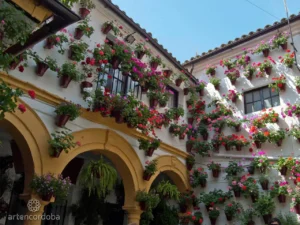




We are now in the popular neighborhood of San Lorenzo, heading to Pastora Street, where Rafael, the owner of the courtyard located at number 2, is waiting for us.
Rafael tells us that this used to be a typical neighbors’ house, where up to ten families once lived together. In 1979, a man acquired the property with the intention of setting up a nut roastery and a warehouse; his idea was to eventually build a home for himself right there, he notes. Apparently, this man changed his mind and decided to sell the lot to the current owner in the year 2000, who then decided to completely renovate it.
Access and architecture of the courtyard
We enter the premises through a large, rectangular hallway. At the end is the courtyard, which we reach through a semicircular arch supported by smooth-shaft columns with black capitals, all of Cordoban origin, as the owners assure us.
We have three types of flooring in the courtyard: terracotta, Cordoban-style pebble mosaic, and marble slabs, Rafael points out. Particularly interesting is the Arab well that was recovered during the renovation of the house, featuring a striking 11th-century curb.
The courtyard chapel
A unique space is, without a doubt, the chapel. The owners have tried to recreate the chapels found in noble Cordoban courtyards, such as the one in the Palace of Viana. They have dedicated it to the Virgin of Health, as before the renovation the house had an image of this devotion and they wanted to honor it.
Vegetation and symbolism
Three large trees are located at the center of the Courtyard of Pastora Street: a laurel, an orange tree, and an olive tree… which, according to Rafael, symbolize the Roman, Arab, and Jewish cultures, respectively. These are accompanied by traditional geraniums and “gitanillas”, as well as the less common bulbous plants, fleur-de-lis, or allium.
Overlooking the ensemble are mosaics of the Virgin of Carmen, of Saint Cajetan, to whom all the family members are devoted followers.
Guided tours of the Patios of Córdoba
If you wish to discover the Patios of Córdoba, do not hesitate to book one of our guided tours. We will pay special attention to the Courtyard of Pastora Street, 2. We are experts in the interpretation of Cordoba’s historical heritage. If you have chosen to go sightseeing in Córdoba, choose a quality option — choose ArtenCórdoba.
Text: J.A.S.C.


