





The construction of the Original Mosque began during the final years of Abd al-Rahman I’s rule, in the summer of 786, and was conceived as a symbol of the power of the independent Umayyad Emirate of Damascus in the West, intended to leave the building as a legacy of that dynasty. The starting point of the mosque was the remains of the Basilica of San Vicente, which were purchased by the Emir from the Mozarabs for one hundred thousand dinars. The space where the building was erected was nearly square in shape and bordered laterally by two parallel streets running North-South—roads that can be identified with the two streets situated to the left and right of the cardo maximus of Colonia Patricia. According to the hypothesis, the cardo maximus runs beneath the main nave of the Original Mosque of Abd al-Rahman I.
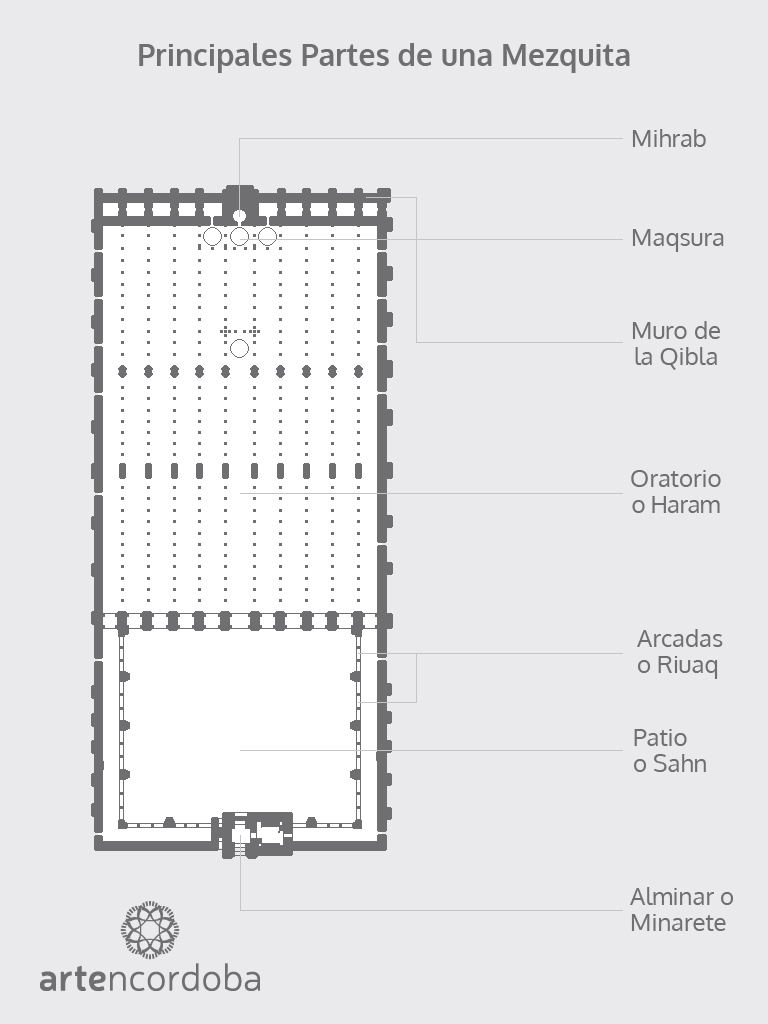
In Andalusian mosques, a deviation to the South-Southeast is characteristic, but it is more pronounced in the Great Mosque of Córdoba, as it is oriented at 169º instead of the 111º prescribed in the Quran. Moreover, our mosque resembles the sanctuary of the Kaaba in its layout and proportions: an elongated square whose dimensions were defined by Félix Hernández. The space is divided into two halves—one covered, the other open (the courtyard). Its shape is an elongated square measuring 79 m per side, of which 42.21 m correspond to the sanctuary and the rest to the courtyard, whose southern side is 1.30 m longer than the northern one.
The Original Mosque was built in the final years of Abd al-Rahman I’s rule
As Oleg Grabar points out, the architects of the Original Mosque of Abd al-Rahman I did not place much emphasis on the accuracy of the measurements or the regularity of the proportions—an asymmetry evident in the foundations of the wall that enclosed the original courtyard to the north, which are not parallel to the qibla, as well as in the southern and northern walls. The perimeter walls of the building, part of which remains in the western section, were constructed of limestone using ashlar blocks laid lengthwise and crosswise, and were reinforced with buttresses resembling small towers, topped with stepped merlons of Eastern tradition.
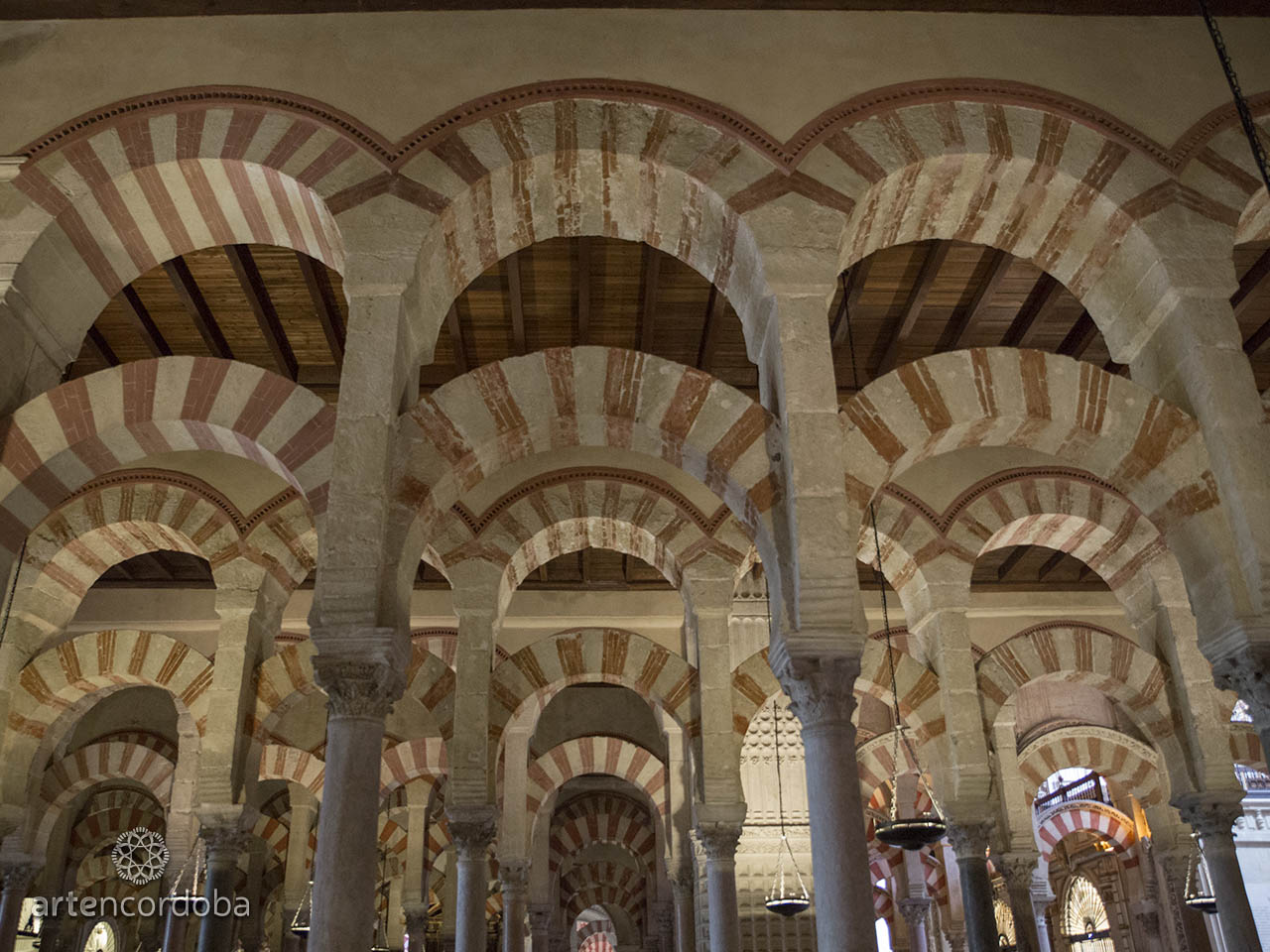
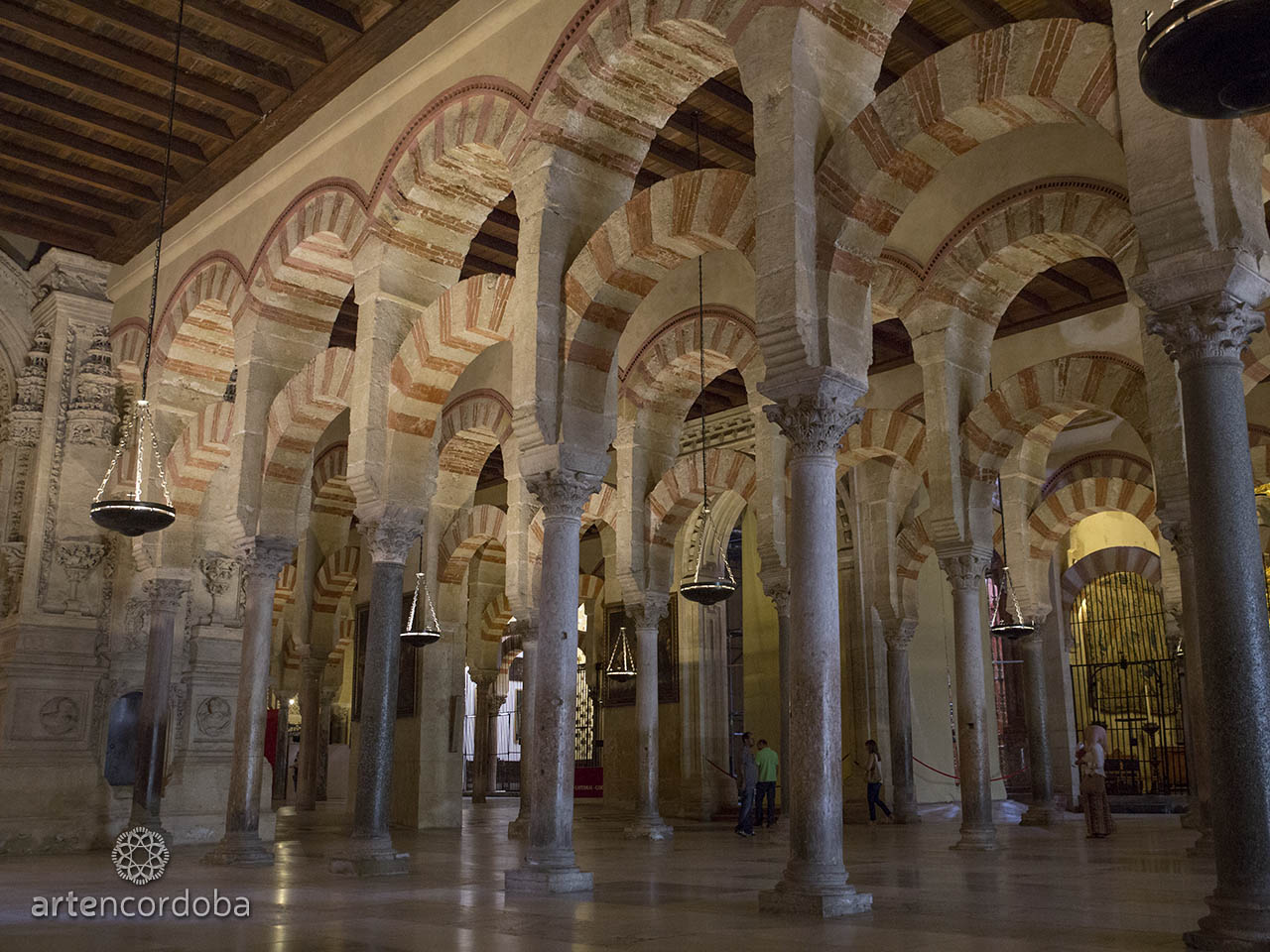
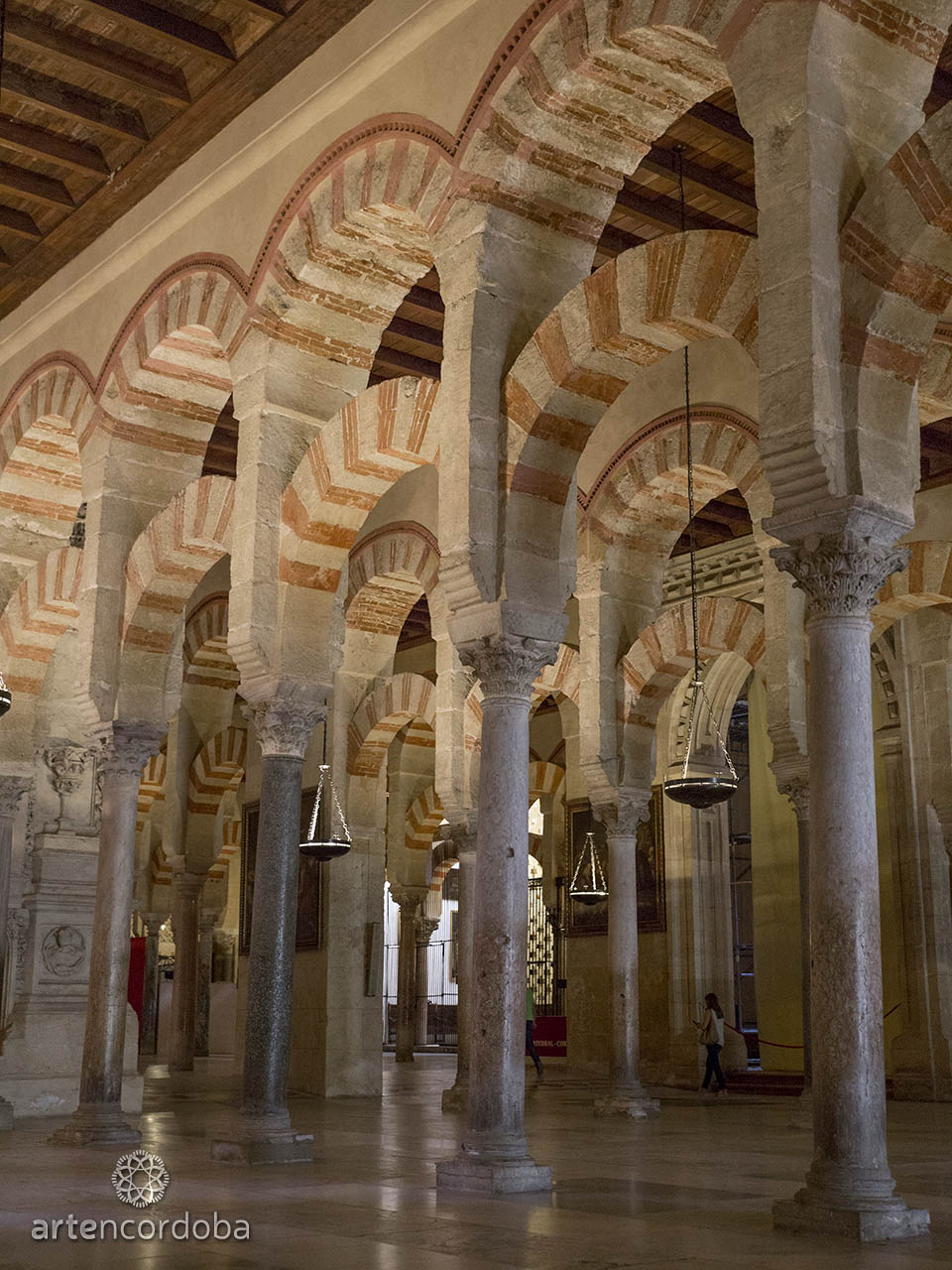
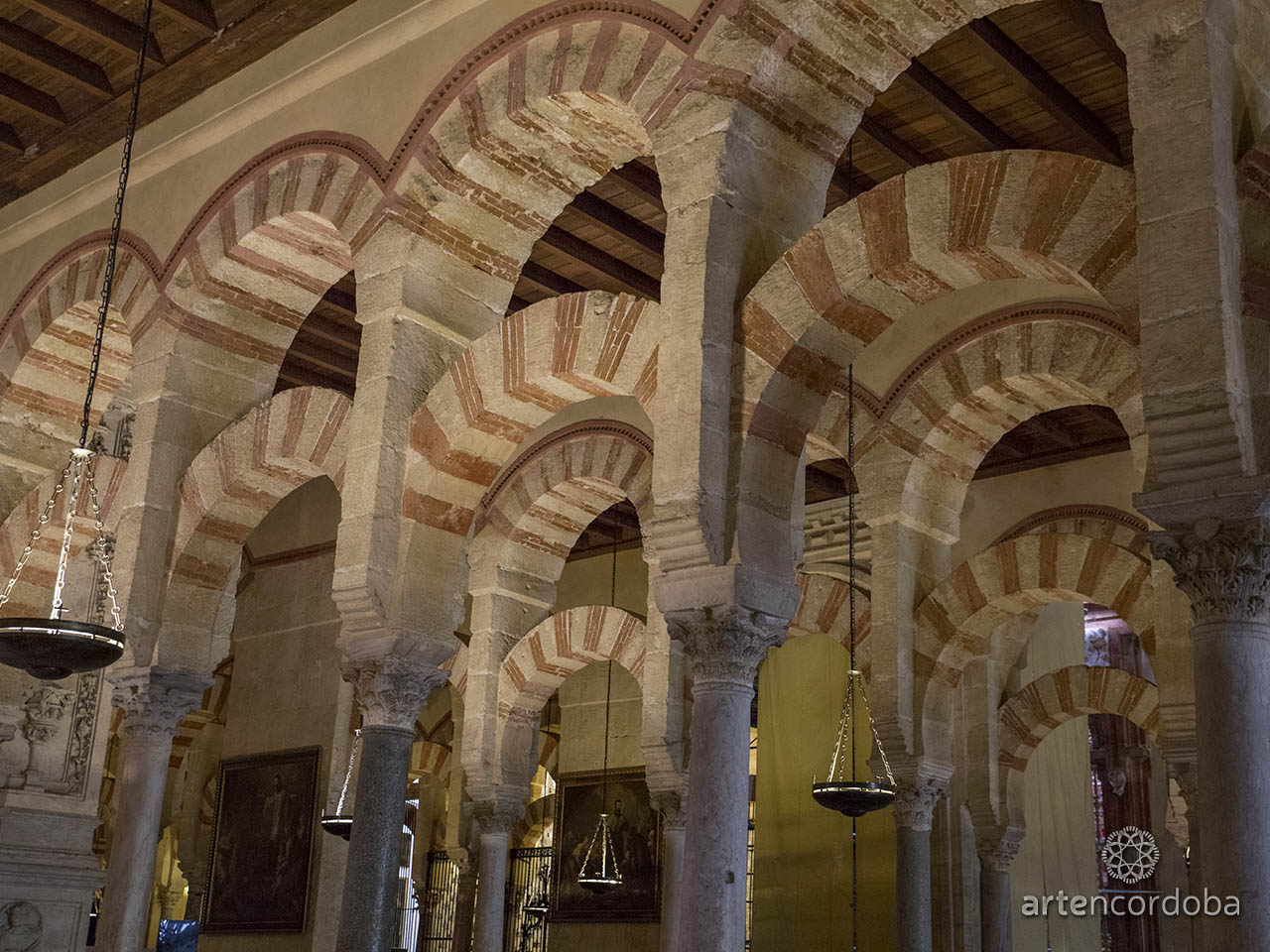
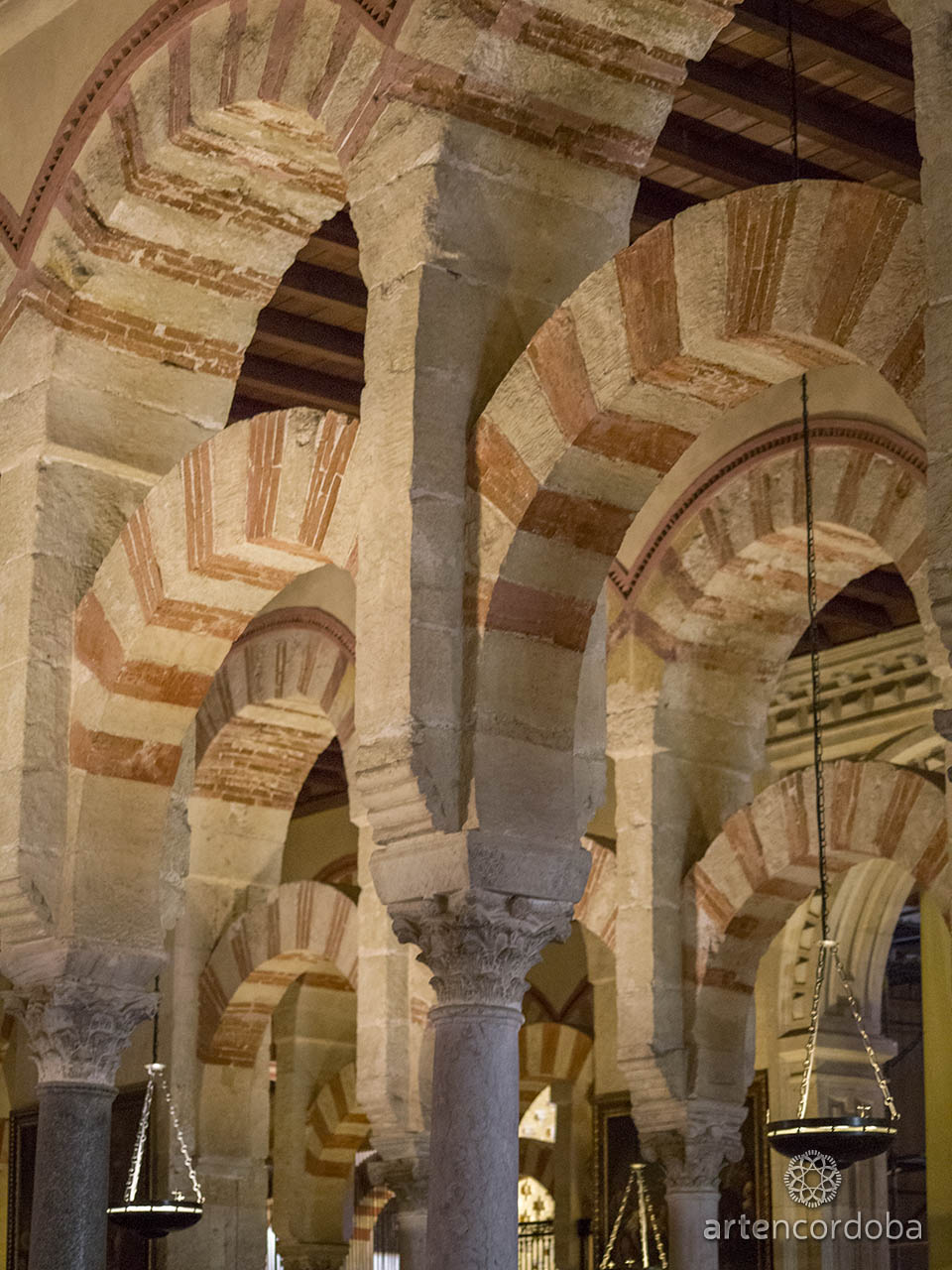
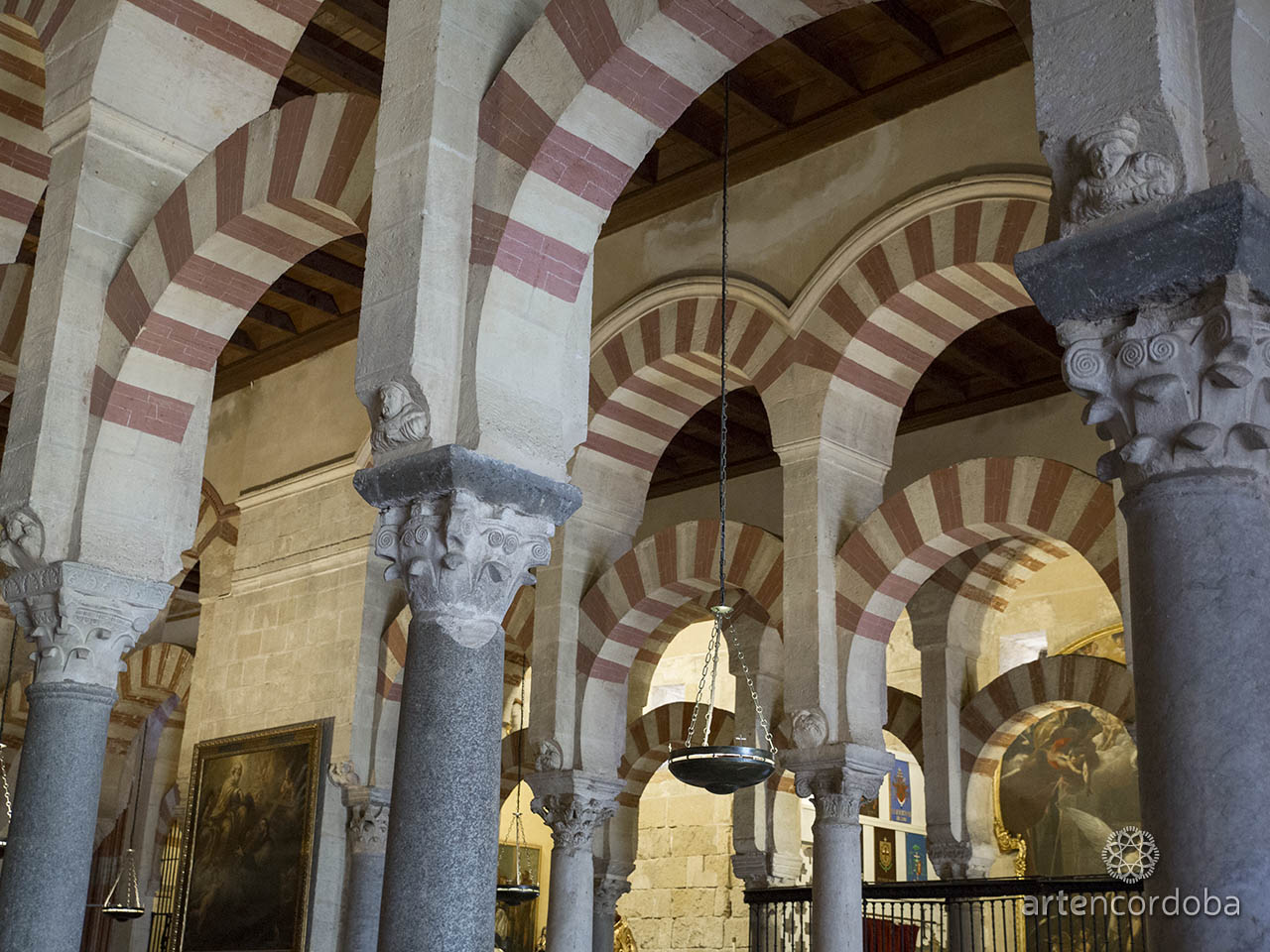
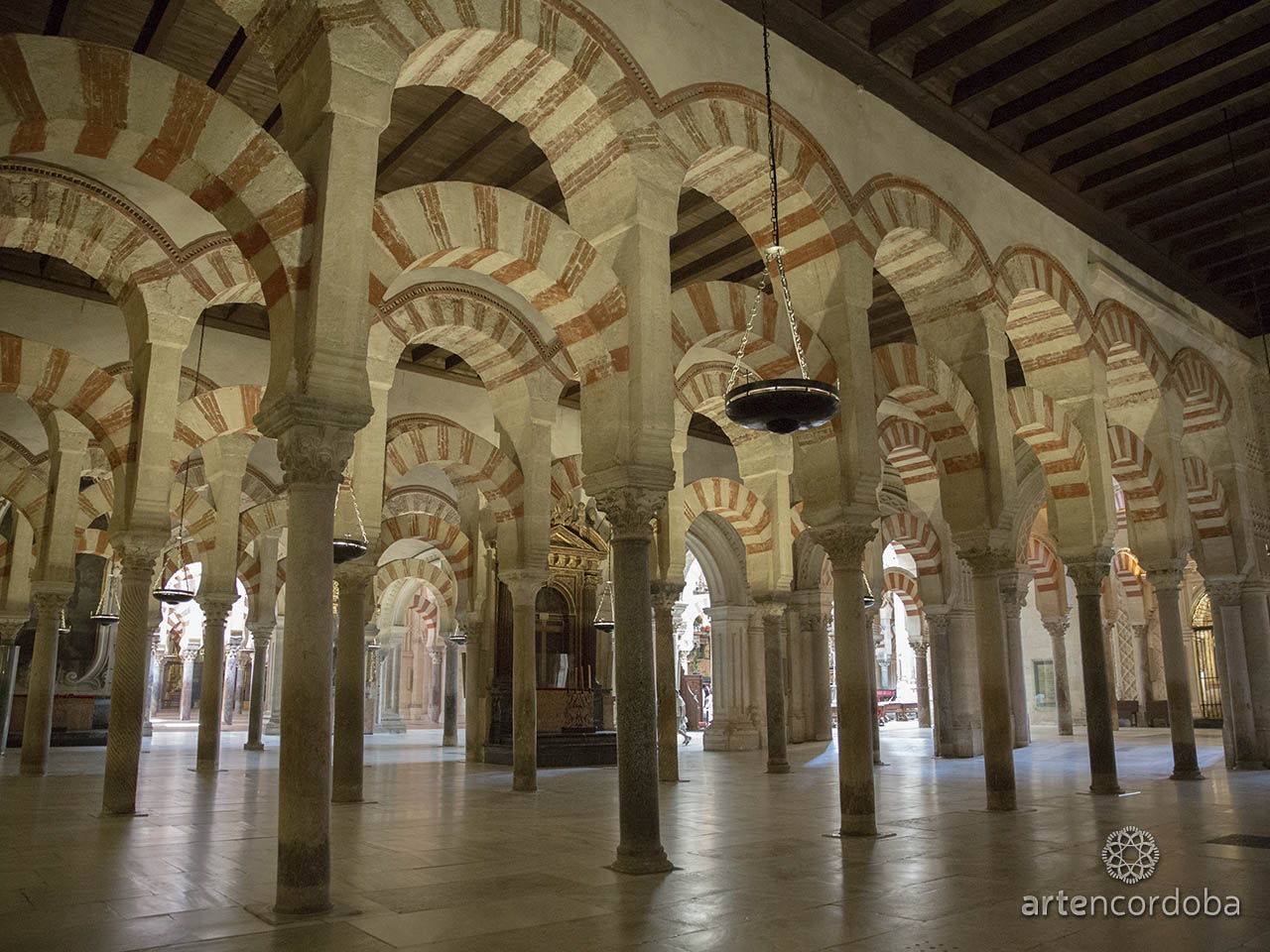
The most remarkable and original feature of the Original Mosque is that its 11 naves are separated by rows of arches on columns. The space is divided into 12 intercolumniations supported by 120 columns. The arcades of the naves face the qibla wall, following a basilical layout different from that of the Umayyad Mosque of Damascus, where the naves run parallel to that wall.
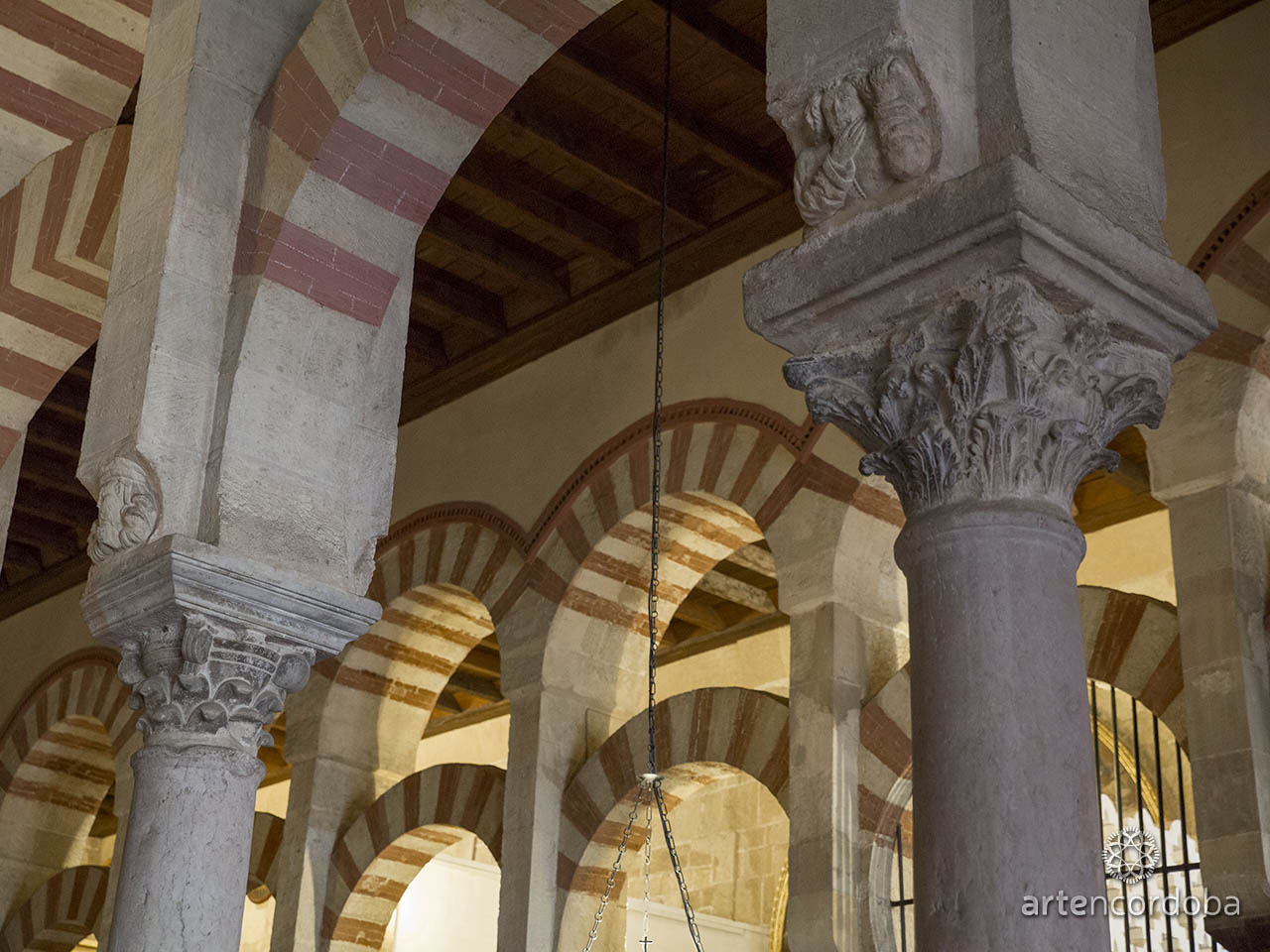
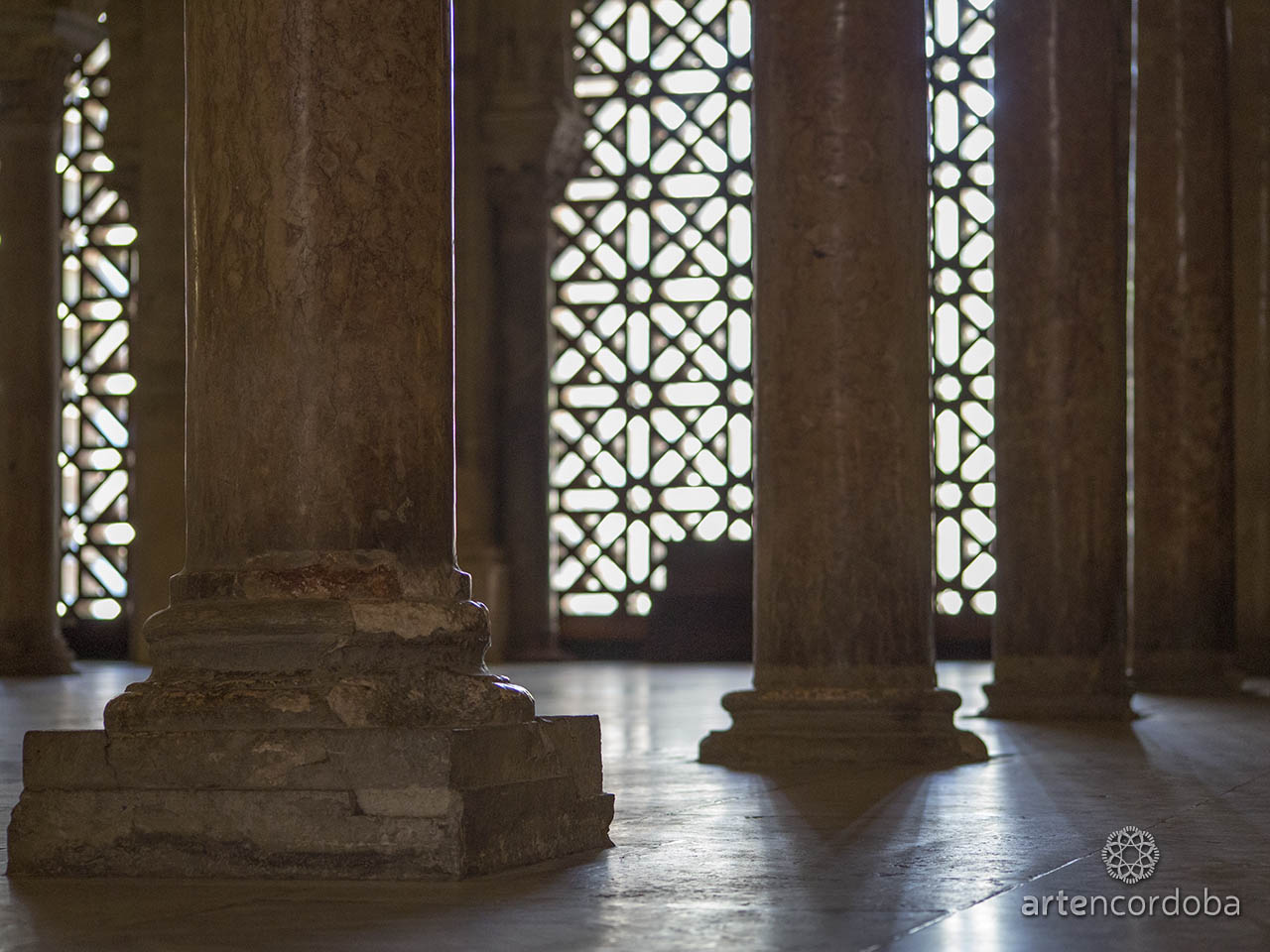
The columns feature bases, capitals, and impost blocks made from repurposed Roman, Byzantine, or Visigothic materials, with marble shafts and capitals; since their lengths vary, the columns were placed on plinths. The alternating materials in the voussoirs of the arches—stone and brick—as well as the superimposed arches, have a Roman origin. The lower arches are horseshoe-shaped—of Visigothic origin—and serve as bracing arches, countering lateral thrusts to maintain the verticality of the columns. The upper arches are semicircular and support the longitudinal wall dividing the naves, a purely Islamic innovation.
The Original Mosque of Abd al-Rahman I was built using repurposed materials
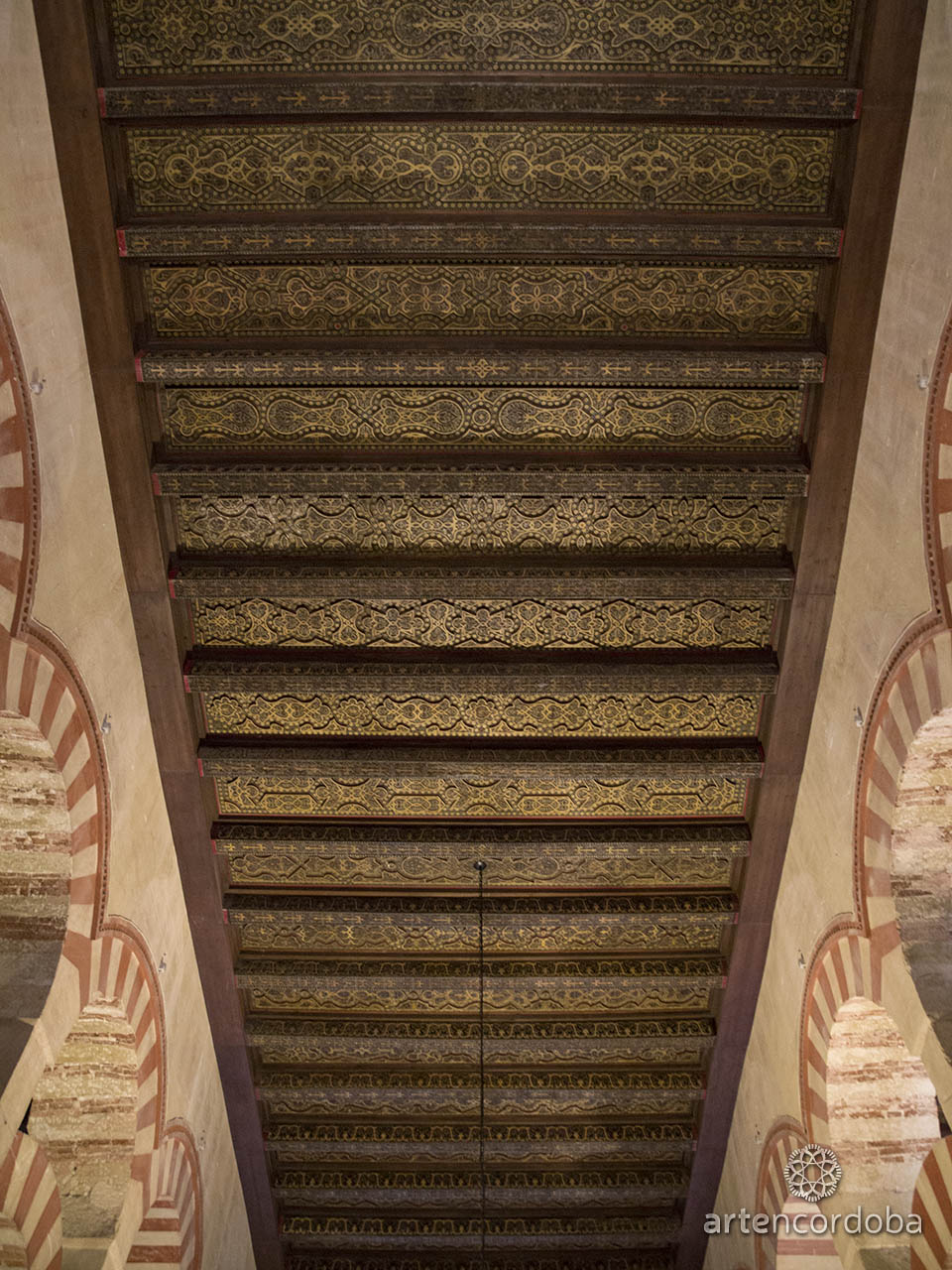
On top of the side walls of the naves, wooden trusses were placed, with tie beams, and above them, the boarding and a gabled roof. The architectural significance of the Bab al-Wazara or Gate of the Viziers (later called San Sebastián and also San Esteban) must also be emphasized, as it represents the first exclusive example of Hispano-Muslim architecture, using purpose-carved materials and an original design that would be repeated in all the doorways of the mosque.
The façade is divided into three vertical axes, the central one being the widest, and into three levels. In the central axis, there are three blind horseshoe arches, separated by panels with ataurique decoration, framed by an alfiz and topped with an original canopy made of roll corbels, in turn crowned by stepped merlons. The first level has three lintelled doors, of which only the central one is functional. In the middle of the second level is the alfiz, which includes the horseshoe arch with decorative vegetal motifs carved into the stone voussoirs; on either side, there are decorative panels of carved stone. Above these panels, on the top level, are two horseshoe arches that enclose another trilobed arch and frame a stone lattice, with jambs also decorated with atauriques. The whole ensemble is flanked by two towers, lending it an Eastern character, while the Cordoban horseshoe arch, framed by an alfiz and spandrels, gives it a distinctly Hispano style.
Lastly, the façade facing the courtyard rests on solid pillars and leaves wide openings to the outside, allowing plenty of light into the prayer hall. This hall is covered with a wooden roof, and its floor was originally red ochre, later replaced by marble slabs by Félix Hernández in the last century.
If you wish to discover the Original Mosque of Abd al-Rahman I, do not hesitate to book one of our guided tours to the Great Mosque-Cathedral of Córdoba. We are experts in the interpretation of Córdoba’s historical heritage. If you’ve chosen to enjoy tourism in Córdoba, choose quality—choose ArtenCórdoba.
Text: Jesús Pijuán.