






We complete the axis of rooms traditionally used for service purposes with the Gardeners’ Courtyard, so named because it once housed the tools of the palace gardening team, specifically in what is now the Multipurpose Room.
The courtyard was once part of the houses of the Counts of Torres Cabrera, acquired by Don Diego Rafael Cabrera y Fernández de Mesa, seventh Marquis of Villaseca and Count of Villanueva de Cárdenas in the 19th century.
Historical Evolution and Decoration
The current appearance of the Gardeners’ Courtyard is due to the fact that the second Marquis of Viana, Don José Saavedra y Salamanca, and later the third Marchioness of Viana, Sofía Amelia de Lancaster y Bleck, incorporated archaeological and decorative elements that today embellish the courtyard, distancing it from what it once was and giving it an air of distinction. Objects were mainly brought from the Palace of Moratalla (Hornachuelos) and the Viana Palace of Madrid, as in many other areas of the Viana Palace.
Description of the Courtyard
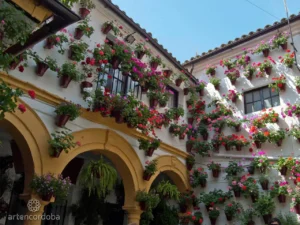
The Gardeners’ Courtyard is adjacent to the aforementioned Courtyard of the Well. It has an irregular and elongated layout. However, it can be described as a typical Cordoban courtyard, where its white walls are almost entirely covered with a multitude of flowers, in this case, jasmine and geraniums.
Walls and Façades
The right wall at the entrance consists of a wall covered with leadwort growing from a stretcher-bond brick flower bed, where various types of geraniums grow. The other main wall is formed by the façade of the palace, with various openings. The upper ones are grilled balconies and windows; the lower ones are blue-painted windows.
Floor, Fountain, and Other Elements
The floor is made of fine, flat brick, and almost at the center, of course, stands a fountain made of gray marble with a basin, adorned with lush vegetation. Almost all doors are flanked by smooth-shaft columns, similar to those used in other courtyards such as the reception or archive courtyards. The balconies, with their corresponding grilles, are decorated with dense vegetation. Additionally, a recently added tile commemorates that the Laguna oil mill was inaugurated in the presence of King Alfonso XIII in the year 1926.
Visit the Gardeners’ Courtyard
If you wish to discover the Gardeners’ Courtyard of the Viana Palace, don’t hesitate to book one of our guided tours. We are experts in the interpretation of Córdoba’s historical heritage. If you have chosen to do tourism in Córdoba, choose a quality option—choose ArtenCórdoba.
🌸 Blooming Calendar
Blooming calendar of the main species that inhabit the Gardeners’ Courtyard
| Species | Jan. | Feb. | Mar. | Apr. | May | Jun. | Jul. | Aug. | Sep. | Oct. | Nov. | Dec. |
|---|---|---|---|---|---|---|---|---|---|---|---|---|
| Leadwort | ● | ● | ● | ● | ● | ● | ||||||
| Cornflower | ● | ● | ● | |||||||||
| Busy Lizzie | ● | ● | ● | ● | ● | ● | ● | ● | ● | ● | ● | ● |
| Petunia | ● | ● | ||||||||||
| Rose | ● | ● | ● | ● | ● | ● | ● | ● | ||||
| Geranium | ● | ● | ● | ● | ● | |||||||
| Hanging Geranium | ● | ● | ● | ● | ● |
Text: J.A.S.C.


