





The Synagogue of Córdoba is located at number 20 of Calle Judíos, right in the Jewish quarter, in the historic center of the city. On the same street, we can find the Municipal Souk, a place where, today, there are numerous workshops of traditional Cordoban crafts.
The truth is that the building has undergone numerous modifications throughout its history, although it largely preserves its original state. In fact, in one of the houses that separate the Synagogue from the stretch of wall, arches and plasterwork in the Mudejar style contemporary to our building have been discovered, which suggests that they may be remains of the same structure.
Access and Interior Spaces
Access to the Synagogue of Córdoba from Calle Judíos is through a small courtyard, from which, through a lowered semicircular archway, one enters the interior of the building. Once inside, we find ourselves in a small rectangular vestibule, on whose eastern side, which adapts to the layout of the street, rises a small staircase that allows us to ascend to the second floor, where the so-called Women’s Gallery is located. We enter the Prayer Hall, almost seven meters per side, through a lintelled doorway.
The Prayer Hall
South Wall
On the South Wall, in the Women’s Gallery, there are three large windows: the side ones are raised semicircular arches, while the central one is lintelled and decorated with plasterwork on its corners. The three openings are framed by rectangular borders containing Hebrew inscriptions, whose characters were gilded on a white background and painted red on a blue background. Above them is a decorative strip, of which the inscriptions that framed it have not survived. Crowning the wall are five arched windows, all of them semicircular.
East Wall
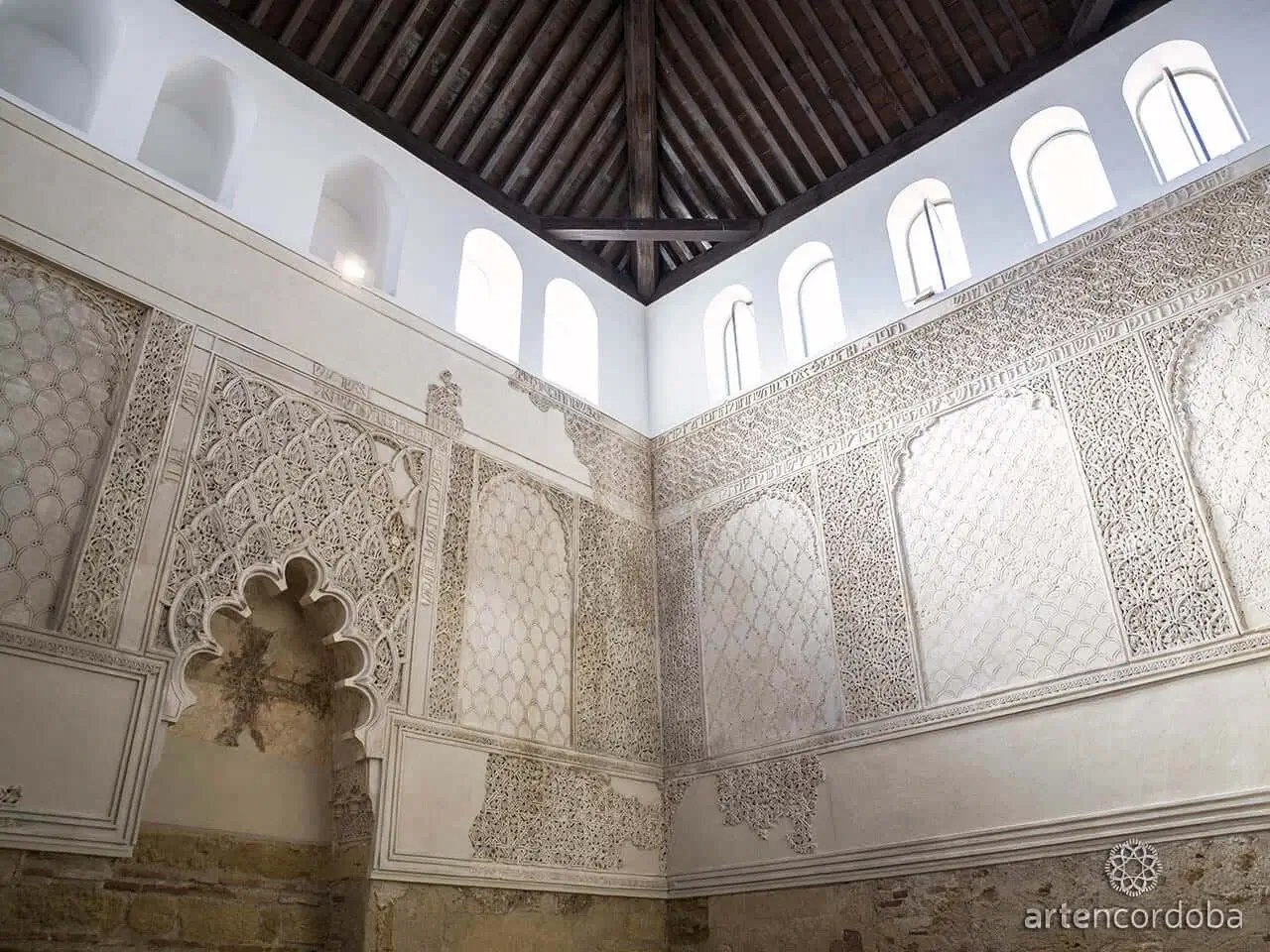
The East Wall has the particular feature of housing a small chamber 2.8 meters deep. The entrance is lintelled, above which a blinded semicircular arch develops; inside, two small niches stand out, where the sacred scrolls of the law were kept, as well as the Torah. The semicircular arch is framed by a richly ornamented alfiz, which in turn is flanked by two large panels decorated with geometric motifs, whose bases supported inscriptions, mostly lost.
North Wall
The North Wall of the Synagogue of Córdoba is the best preserved today, being covered with rich plasterwork decoration. Like the South Wall, it is crowned by five semicircular windows that provide natural light to the room. Just below runs a horizontal strip flanked by small friezes with inscriptions, and beneath these are three blind arches: the side ones semicircular and the central one lintelled, as in the South Wall. The baseboard that serves as the base of the wall, as with the rest of the room’s sides, has not been preserved.
West Wall
The West Wall features a small niche where the Rabbi’s pulpit was probably located. The niche is covered by an exceptional lobed ogival arch, suspended on corbels. It is framed by a richly decorated alfiz, which is in turn covered by a small frieze housing an incomplete inscription from The Song of Songs. In the last restoration, a black and red painted cross was found on the wall that houses the arch, most likely dating from the time when the building served as a hospital.
Visit the Synagogue of Córdoba
If you would like to visit the Synagogue of Córdoba, do not hesitate to book one of our guided tours of the city. We are experts in the interpretation of Cordoban historical heritage. If you have chosen to do tourism in Córdoba, choose a quality option, choose ArtenCórdoba.
Text: J.A.S.C.