






The house dates back to the 15th–16th centuries, according to Miguel Ángel Roldán, president of the Association of Friends of the Cordoban Patios, current owner of the property.
History of the Patio
Miguel Ángel tells us that in this Patio on San Basilio Street, 44 (formerly 50), up to 13 families once lived—one for each room. They shared the bathroom, the kitchen, the laundry sink, the well… everything revolved around the patio, which was the center of community life.
In the 1960s, the residents began to leave the property in search of greater comfort and privacy. It was then that the newly created Association of Friends of the Cordoban Patios acquired the patio, as well as the one at the House of the Bells, in both cases with a firm goal: to prevent this type of building from disappearing.
Current Use of the Patio
After acquiring the property, the association sought to bring it to life on a daily basis, since it spent much of the year closed. One initial idea was to turn it into a rural hotel, but this was ultimately not carried out due to the building’s conditions. They then chose to rent the ground-floor rooms to local artisan businesses, and that is how we find it today. In the patio, you can find a leather workshop, a ceramics studio, hand-painted fans, a perfumery… as well as the headquarters of the Salmorejo Brotherhood and the board of the Association of Traditional Booths of the Córdoba Fair.
Architecture and Details
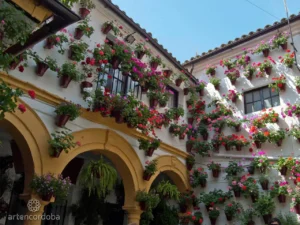
The patio has three of its four sides with arcades, featuring whitewashed stone pillars and covered upper terraces. One striking feature is the staircase centered on the front wall—very steep and straight, completely whitewashed, with wooden handrails, like the slender pilasters of the terrace it leads to. It still preserves the original floor, made of river pebbles, which gives it great beauty.
On its right side stands the old well, also whitewashed, though barely visible under the whitewash as it is completely adorned with flower-filled pots. The old metal bucket hanging from the rope and pulley especially draws attention. In one of the rooms, the communal laundry sinks once used by all the neighbors are still preserved.
Also striking in this patio are its dark wooden doors and windows, through whose glass you can glimpse the ancient polka-dot curtains. All its rooms are covered with small roofs made from traditional Arab tiles.
Flora and Atmosphere
The entire Patio on San Basilio Street, 44 (formerly 50) is covered with flower-filled pots, offering a strong contrast against the white walls, adding vibrant color to the space, and filling it with fragrance. Among the flowers are roses, night-blooming jasmine, rosemary, mint, jasmine, thyme, basil, and honeysuckle.
Recommended Visit
If you’re wondering what to do in Córdoba, we recommend visiting the Patios of Córdoba by booking one of our guided tours. We’ll dedicate a special section to the Patio on San Basilio Street, 44 (formerly 50). Choose quality tourism with qualified staff—don’t hesitate, ArtenCórdoba is the best option.
Text: J.A.S.C.


