


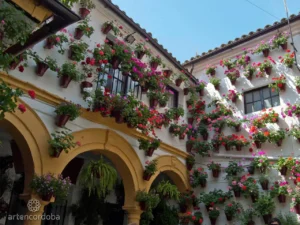




In the section regarding the owners of the house, we already mentioned the major renovations undertaken by the Marchioness, Ana Rafaela Fernández de Mesa, in the 18th century. These renovations focused on the remodeling of the Patio de la Madama and the creation of the historical archive of the Palacio de Viana, located in the courtyard in question.
A note found in the archive reads: “On August 29, 1975, the archive of my lady’s house, the Marchioness of Villaseca, began to be organized. Pedro del Río earns 6 reales de vellón per day and is paid weekly.”
The archive collection of the Palacio de Viana was declared a Documentary and Bibliographic Treasure of the Nation in 1980, shortly before it was acquired by the financial institution Cajasur. Nevertheless, the archive was excluded from the purchase, and no one was able to access it for study and classification for several decades. It was in the year 2000 that the mentioned bank finally acquired it, marking a new chapter for the palace, as there were many gaps this archive would help fill. It contains over 300,000 documents dated between the 12th and 20th centuries, a gem yet to be fully explored.
Architectural Description of the Archive Courtyard
Without a doubt, it is the most interior courtyard of all those in the palace, and also one of the most austere in the complex. Its decoration corresponds to the 18th-century taste, although it is the only example of plate-style Baroque in the palace. Plate Baroque is a style very common in mid-18th-century Córdoba, with well-preserved examples such as the façades of the Church of San Hipólito or San Pedro de Alcántara.
The doors of the Archive Courtyard are flanked by recessed pilasters topped with false capitals, extending up to the balconies and cornices. A splendidly crafted plate decoration frames these balconies, contributing to the creation of a harmonious whole.
Vegetation and Central Fountain
Its white walls contrast with the deep green of the centuries-old mandarin orange trees placed in the corners, enclosed within triangles of boxwood and violets. In the center, a beautiful fountain with a twelve-sided pillar covered in Sevillian tiles gives the whole space great personality and elegance.
🌸 Blooming Calendar
Blooming calendar of the main species inhabiting the Archive Courtyard
| Species | Jan. | Feb. | Mar. | Apr. | May | Jun. | Jul. | Aug. | Sep. | Oct. | Nov. | Dec. |
|---|---|---|---|---|---|---|---|---|---|---|---|---|
| Mandarin Orange | ● | ● | ● | ● | ● | ● | ● | |||||
| Violet | ● | ● | ● | ● | ● | |||||||
| Clivia | ● | ● | ||||||||||
| Calla Lily | ● | ● | ● | |||||||||
| Ivy Geranium | ● | ● | ● | ● | ● | |||||||
| Lady of the Night | ● | ● | ● | ● | ● | ● | ||||||
| Geranium | ● | ● | ● | ● | ● | |||||||
| Chinese Geranium | ● | ● | ● | ● | ● |
Visit the Archive Courtyard
If you’re wondering what to visit in Córdoba, a great option would be the Palacio de Viana, choosing one of our guided tours. This way, you can learn everything about the Archive Courtyard. Choosing high-quality tourism means choosing ArtenCórdoba.
Text: J.A.S.C.


