






The Patio of the Cats is one of the most peculiar and lesser-known parts of the palace. It once belonged to the Houses of the Puentezuela de Tres Caños, a group of annexed houses that at the time occupied the southern corner of what is now the Palace of Viana. In the mid-16th century, they were acquired by the first Lord of Villaseca, Don Gómez de Figueroa y Córdoba, but he lost them in a legal dispute in favor of his daughter, who claimed them as inheritance after the death of her mother.
These houses were used as rental homes, and remained so for many years, even after the fourth Lord of Villaseca, Don Luis Gómez Bernardo Fernández de Córdoba, reclaimed the property. It wasn’t until the mid-18th century that these quarters were definitively connected with the rest of the complex, initially serving as accommodation for the palace administrators.
By the end of the 19th century, it began to be known as the Kitchen Courtyard, since the surrounding rooms housed the various kitchens of the palace, and it had become a thoroughfare for the service staff.
In the 20th century, it came to be known as the Patio of the Cats, due to the felines that roamed the area in search of food. As mentioned earlier, the kitchens were nearby, and the animals, attracted by the smell, came looking for something to eat.
Courtyard Description
The Patio of the Cats is accessed through a small and austere room, with a simple coffered ceiling and a central wall that intersects a shared well with an Arab-style curb. The courtyard is rectangular in shape and quite narrow.
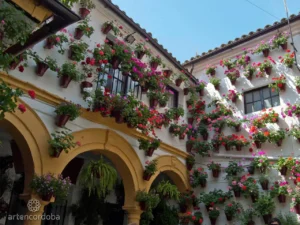
Until recently, the Patio of the Cats was not open to visitors. It was restored and decorated with the aim of completing the dozen courtyards open to visitors at the Palace of Viana, as well as to provide an authentic example of the popular Cordoban courtyard style. As a former communal patio, it showcases its whitewashed walls, adorned with pots of geraniums and ivy-leaved pelargoniums, and a traditional washing basin that can be seen on one side.
The Courtyard as a Space for Community Life
These communal courtyards were gathering places for neighbors, representing an open-door lifestyle, different from today’s, where division and isolation seem to be the norm.
Visiting the Patio of the Cats
If you’re wondering what to do in Córdoba, we recommend visiting the Palace of Viana by booking one of our guided tours. There, we dedicate a special section to the Patio of the Cats. Choose high-quality tourism with qualified staff—don’t hesitate, ArtenCórdoba is your best option.
🌸 Blooming Calendar
| Species | Jan. | Feb. | Mar. | Apr. | May | Jun. | Jul. | Aug. | Sep. | Oct. | Nov. | Dec. |
|---|---|---|---|---|---|---|---|---|---|---|---|---|
| Begonia | ● | ● | ● | ● | ● | |||||||
| Ivy-leaved pelargonium | ● | ● | ● | ● | ● | |||||||
| Geranium | ● | ● | ● | ● | ● | |||||||
| Carnation | ● | ● | ● | ● | ● | ● | ● | |||||
| Pericón | ● | ● | ● | |||||||||
| Cat’s claw | ● | ● | ● | ● | ● | ● | ● |
Text: J.A.S.C.


