


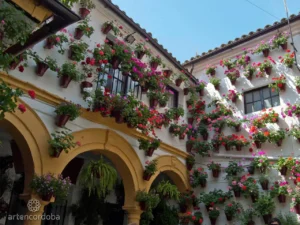




The first of the courtyards we will visit is the Main Courtyard, also known as the Reception Courtyard, as this was where guests visiting the marquises were received. It was the main entrance to the palace, as we will see later on.
Visible from the outside, the main function of this courtyard is to offer an exquisite antechamber to what the palace will later reveal, aiming to impress anyone who visits.
Architecture of the Main or Reception Courtyard
The Main or Reception Courtyard has a trapezoidal, almost rectangular layout, surrounded by porticoed galleries on the ground floor, which open to the outside through semi-circular arches resting on smooth-shaft columns with Tuscan capitals. The absence of a column, which should be located at the corner where we entered, is striking; this is due to the need at the time to allow carriages to enter the premises. It is believed that the second floor may have had another porticoed gallery, where there are now blue-painted lintelled windows, reminiscent of old Muslim Córdoba.
Royal visits and decoration
On either side of the door, two decorated tiles with inscriptions commemorate royal visits. One was made by King Alfonso XIII, a close friend of the second Marquis of Viana, in 1921, and the other by the Prince of Asturias, accompanied by his brother Infante Don Jaime, who stayed in the palace during his first visit to the city in 1927.
Vegetation
The vegetation is meticulously maintained, with highlights including clivias, plumbagos, night-blooming jasmines, bougainvilleas, and other more common plant species that infuse the courtyard with fragrance and freshness. In the center stands a large palm tree, surrounded at its base by torcílago, clivia, and a boxwood hedge, its crown rising above the rooftops of the house.
Flooring and ornamentation
The floor of the Main or Reception Courtyard is paved with small light and dark pebbles, forming decorative patterns that give the space great dynamism. It was made around 1923, following the model of the galleries, which were older.
Archaeological remains
Both in the courtyard and in the surrounding galleries, numerous archaeological pieces can be seen, such as jars, capitals, column bases… more than fifty relics are preserved in this courtyard. Noteworthy is a small image of a 14th-century Gothic “Virgin“, located in front of the main staircase, as well as a bas-relief representing “The Flagellation of Christ“. Both pieces are anonymous and made of stone.
Guided tours
If you wish to visit the Main or Reception Courtyard of the Viana Palace, do not hesitate to book one of our guided tours. We are experts in the interpretation of Córdoba’s historical heritage. If you’ve chosen to do tourism in Córdoba, choose a quality option—choose ArtenCórdoba.
🌸 Blooming Calendar
Blooming calendar of the main species found in the Main or Reception Courtyard
| Species | Jan | Feb | Mar | Apr | May | Jun | Jul | Aug | Sep | Oct | Nov | Dec |
|---|---|---|---|---|---|---|---|---|---|---|---|---|
| Plumbago | ● | ● | ● | ● | ● | ● | ||||||
| Date Palm | ● | ● | ● | ● | ||||||||
| Miniature Rose | ● | ● | ||||||||||
| Clivia | ● | ● | ||||||||||
| Bauhinia (Orchid Tree) | ● | ● | ● | |||||||||
| Night-Blooming Jasmine | ● | ● | ● | ● | ● | ● | ||||||
| Bougainvillea | ● | ● | ● | ● | ● | ● | ● |
Text: J.A.S.C.


