






The Organization of a Processional Parade
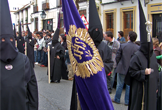
There are numerous variables surrounding a Holy Week procession, although not all brotherhoods share the same characteristics in their parades. In this section, we aim to provide you, in broad strokes, with a general overview of how a processional parade is organized, from the first of the nazarenes to the actual Elder Brother.
The Senior Procession Officer
The person ultimately responsible for organizing a processional parade is usually a member of the Governing Board, which is elected along with the Elder Brother every four years by the members of the brotherhood. This member holds the title of “Senior Procession Officer” or “Procession Officer”. This person is responsible for drawing up the “procession list”, a list that must include the names of all those who will form part of the procession on the day of the parade.
According to each brotherhood’s tradition, the order of the nazarenes may vary, whether they carry banners or just candles. However, the most common practice is for the more senior nazarenes to be positioned further back, closer to the titular images.
Rules and Preparation for the Penitential Procession
A brotherhood’s processional parade follows a set of rules.
As Lent approaches, each brotherhood distributes an informational bulletin to update members on the current affairs of the brotherhood, the projects that have been completed, and those that are planned. The bulletin is often used to announce the dates when those interested in participating in the penitential procession can visit the brotherhood’s premises to collect their site pass (a document that indicates the person’s name and the position they will occupy in the processional parade, as well as the role they will hold).
Requirements to Participate in a Procession
In order to take part in a procession, a person must meet a series of requirements, depending, of course, on the specific brotherhood. However, there are usually no major differences. The main requirement is to be a member of the brotherhood, and they must also have fully paid the annual fee.
Nowadays, however, and for various reasons, the “costaleros” (bearers) are usually exempt from these obligations. Nonetheless, it would be unfair to overlook the figure of the “brother costalero” who, despite being a bearer, fulfills his duties to the brotherhood just like any other hooded member.
The Day of the Processional Departure
Now placing ourselves on the day of the parade, in the moments before the start of the penitential procession, we return to the figure of the Procession Officer who, in addition, must be the one to knock on the door of the church for the Guiding Cross to begin its journey.
From the moment the brotherhood is on the street until it returns, the Procession Officer is the highest authority of the parade, and not even the Elder Brother may overrule their decisions. However, not all decisions are made by this official, as they are supported by other officers or marshals.
Other Roles During the Procession
Among these roles is the “Time Officer”, responsible for ensuring that the brotherhood adheres to the scheduled timetable, and the “Section Officers”, who are in charge of maintaining order within each section of nazarenes. There are also “Float Marshals”, responsible for everything concerning the float, including timing, music, and more.
The Elder Brother, provided he is neither the foreman nor a bearer—something increasingly common in our city—closes the procession of nazarenes before the canopy float, flanked by other brotherhood officials and carrying the “Elder Brother’s Staff”.
Holy Week and Tourism in Córdoba
If you’re wondering what to do in Córdoba, we recommend experiencing its Holy Week by booking one of our guided tours. Choose quality tourism with qualified staff—don’t hesitate—ArtenCórdoba is the best option.
Text: J.A.S.C.