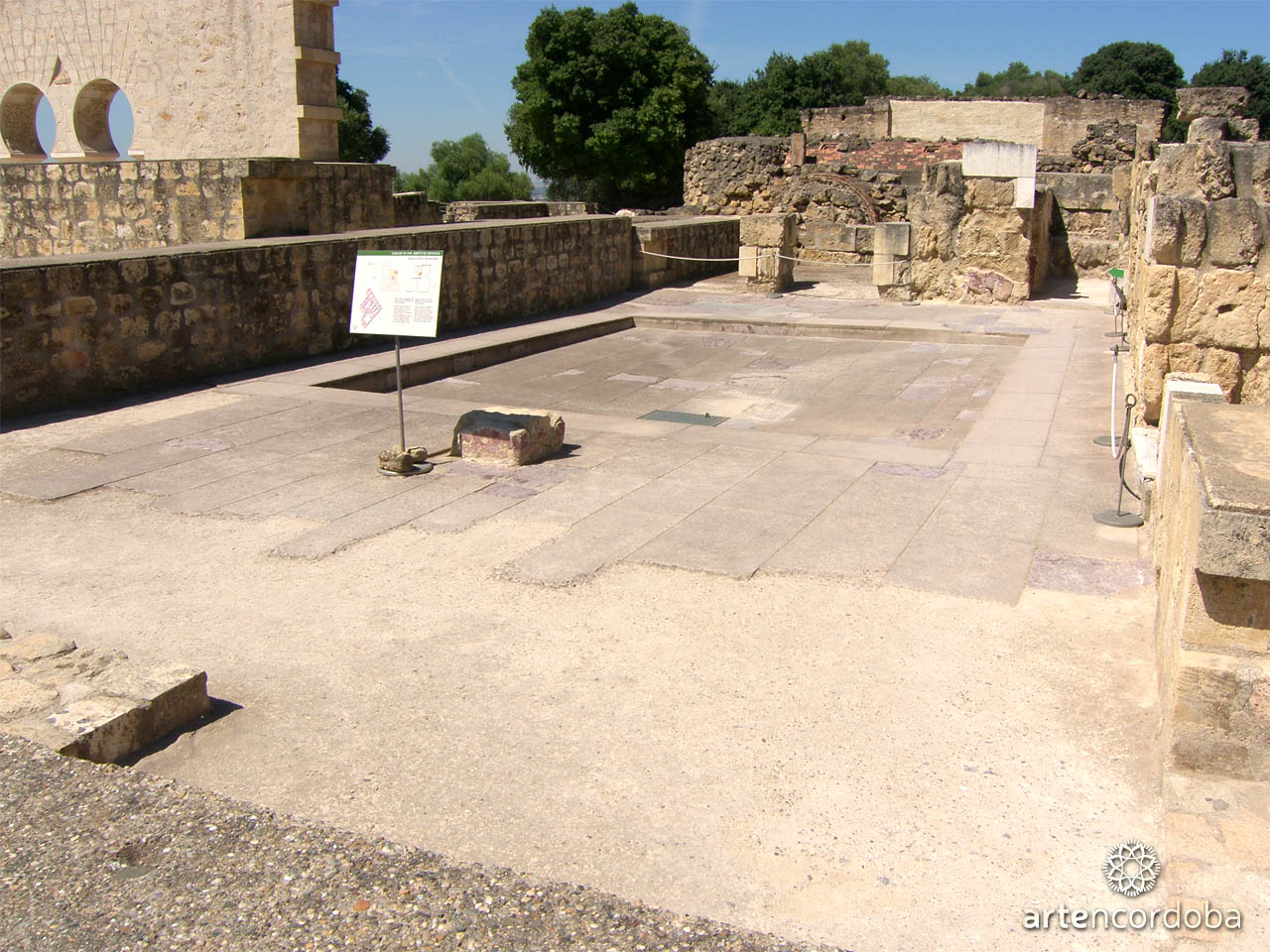






Of the two residences located south of the Service Dwellings, the eastern one is the House of Ya’far. It takes its name from Ya’far ibn Abderramán, appointed prime minister (hajib) in the year 961 and who died ten years later. This figure is especially significant in the artistic field, since during the time he held the office of prime minister he directed the works of the central pavilion of Medina Azahara and the expansion of the Mosque of Córdoba ordered by Caliph al-Hakam II, as indicated in the inscription of the mihrab. The coincidence between the accession to the throne of the aforementioned caliph and the appointment of Ya’far ibn Abderramán as prime minister makes it possible to place the beginning of the construction of the House of Ya’far on the former date mentioned, the year 961, in the absence of other documentary or epigraphic evidence.
Organization and function of the building
The organization of the building was adapted to a delimited space of prior use in which there were constructions that were either transformed or abandoned in order to build others. The dwelling was conceived as a residence for the personal use of the high-ranking figure of the caliphal court mentioned above. Its structure articulates three spatial areas, organized around their corresponding courtyards: one public, one private, and one for service.
The official space
The official space of the House of Ya’far consists of a building with a plan comparable to a basilica, with three longitudinal naves that communicate with each other through doors with horseshoe arches, and a transverse nave open to the courtyard, where the correspondence between the longitudinal naves and the façade is interrupted in order to adapt the latter to the space created by the construction of an adjoining bath.
The façade is organized by means of a triple horseshoe arch supported by columns. As for the decoration of the building, it was paved with thick slabs of white marble, except in the courtyard, where violaceous limestone stones were used. Particularly noteworthy is the ataurique decoration of the façade, with vegetal and geometric themes, also present in the opening that connects the transverse nave and the central nave, which features corresponding panels on the fronts and jambs of the opening.
The private space
On the eastern side of this area there are a latrine and a corridor, stepped in depth, which allows passage to the private area of the house. This second space includes a series of rooms culminating in the alcove, preceded by a courtyard with a marble basin located in the center and a fountain.
The service space
On the western side, the annexed rooms, which must have been built prior to the construction of the House of Ya’far itself, connected with the private area and were incorporated into the dwelling, forming its service space.
Visiting the House of Ya’far
If you wish to visit the House of Ya’far in Medina Azahara, do not hesitate to book our guided tours. We are experts in the interpretation of Córdoba’s historical heritage. If you have chosen to enjoy tourism in Córdoba, choose a quality option—choose ArtenCórdoba.
Text: Jesús Pijuán.