






Courtyards of Alcázar Viejo – Jewish Quarter
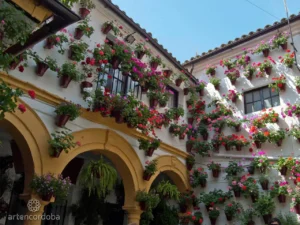
The route of the Patios of Alcázar Viejo and the Jewish Quarter brings together some of the most iconic and traditional domestic spaces in Córdoba. In these historic neighborhoods, where the medieval layout and Andalusian heritage still endure, patios remain the heart of daily life: places of gathering, freshness, and beauty. Their shapes, vegetation, and layout reflect centuries of architectural and cultural evolution, carefully preserved by their owners.
The patios of the Alcázar Viejo, birthplace of the Patios Festival and one of the oldest neighborhoods outside the city walls, retain the essence of the traditional Córdoba patio. Meanwhile, the patios of the Jewish Quarter offer more intimate spaces, often part of old stately homes, where Hebrew and Christian architecture intertwine in harmony. Together, they offer a unique journey through the city’s heritage identity.
Visit-worthy patios of Alcázar Viejo and the Jewish Quarter
Below is a selection of notable patios from both areas, each with its own personality and open to visitors for most of the year:
- Patio at Calle Postrera, 28 (Alcázar Viejo)
- Patio at Calle San Basilio, 44-50 (Alcázar Viejo)
- Patio at Calle San Basilio, 22 (Alcázar Viejo)
- Patio at Calle San Basilio, 14 (Alcázar Viejo)
- Patio at Calle Martín Roa, 7 (Alcázar Viejo)
- Patio at Calle Judíos, 6 (Jewish Quarter)
- Patio at Calle Céspedes, 10 (Jewish Quarter)
- Patio at Calle Encarnación, 11 (Jewish Quarter)
- Patio at Calle Rey Heredia, 22 (Jewish Quarter)
A tour through two emblematic neighborhoods
Patios of Alcázar Viejo
The patios of Alcázar Viejo stand out for their traditional structure, generally organized around a spacious central courtyard, with an abundance of flower pots, wells, cobblestones, and open galleries. Their houses, dating back to the late Middle Ages, were inhabited by crossbowmen and artisans, preserving the most popular and authentic character of the Córdoba patio.
Patios of the Jewish Quarter
In the Jewish Quarter, patios tend to be smaller, more intimate, and connected to old stately homes or workshops. The narrowness and winding layout of its streets make these patios function as small inner oases, where silence, the scent of orange blossom, and the sound of water create a quiet and special atmosphere.
Visiting the patios of Alcázar Viejo and the Jewish Quarter
If you wish to explore the patios of Alcázar Viejo and the Jewish Quarter in depth, don’t hesitate to book one of our guided tours. We are experts in the interpretation of Córdoba’s historical heritage. If you’ve chosen to enjoy tourism in Córdoba, choose a quality option: choose ArtenCórdoba.
The patios of Alcázar Viejo have a more traditional and popular structure, with large central spaces and abundant decoration, while the patios of the Judería are more intimate, linked to noble houses and reflect a quieter, more secluded atmosphere.
These patios represent centuries of architectural and cultural evolution in Córdoba, preserving the Andalusian and Christian essence of the city, and are a living expression of its historical and domestic identity.
The Alcázar Viejo neighborhood was inhabited by archers and artisans since the late Middle Ages, resulting in popular character patios, with wells, cobblestones, and open galleries that still retain their original essence.
The patios of the Judería offer a more intimate experience, with small charming interior spaces where silence, the sound of water, and the aroma of orange trees combine in an environment of great historical value.
Yes, many patios of Alcázar Viejo and the Judería are open to the public for much of the year, and it is possible to visit them through self-guided tours or specialized guided visits that explain their history and uniqueness.
Table of contents
Popular visits
Guided Tour Mosque of Cordoba
From:
Guided Tour to Medina Azahara
From:
Guided Tour to the Alcazar of Cordoba
From:
