


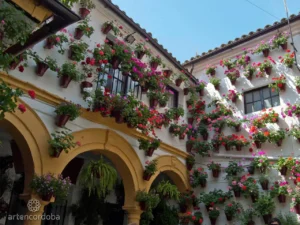




The Chapel Courtyard, like the previous three (Alberca, Pozo, and Gardeners), belonged to the houses of the Marquises of Torres Cabrera. However, this was their main courtyard, which explains the stylistic differences compared to the others.
The courtyard, built in the 17th century, features two of its four porticoed galleries, with semicircular arches made of exposed brick resting on smooth-shaft columns with Tuscan capitals. One of the two porticos housed the chapel of the Viana Palace, which gives the courtyard its name. The gallery is covered with a simple wooden coffered ceiling and paved with flat brick, deeply rooted in Cordoban tradition.
The Chapel and its Paintings
From the chapel adjoining the courtyard, recently restored, three valuable paintings stand out, all part of the Cajasur Collection: “Saint Raphael” and “Saint Michael“, works by Juan de Valdés Leal, and an “Allegory of the Defense of the Immaculate Conception by the Franciscans“, attributed to the circle of the Cordoban painter Antonio del Castillo.
Decoration and Archaeological Elements
Everything is richly decorated with archaeological elements, serving to highlight the family’s economic and social power. Two Roman mosaics adorning the walls stand out above the rest. One of them, heavily reconstructed, depicts a scallop shell; the other is unique in that it is not made of tesserae, as is usual, but from regular geometric shapes of pink marble, which makes it particularly rare.
The second floor is barely visible due to the dense vegetation, so the blue-painted windows, similar to those mentioned in the previous courtyard, must be almost guessed.
Vegetation and Central Fountain
Eight century-old orange trees adorn the Chapel Courtyard, bordered by spider plants that both frame and shade the area. At the center stands a fountain with an octagonal base and various spouts, covered with a large number of ferns. Ivy covers much of one of the non-porticoed walls, while on the opposite side, a series of glass doors open onto the Saavedras Hall, which is currently not open to visitors.
Visit to the Chapel Courtyard
If you’re wondering what to do in Córdoba, we recommend visiting the Viana Palace by booking one of our guided tours. There, we will dedicate a special section to the Chapel Courtyard. Choose to enjoy high-quality tourism with qualified personnel—don’t hesitate, ArtenCórdoba is the best option.
🌸 Blooming Calendar
| Species | Jan. | Feb. | Mar. | Apr. | May | Jun. | Jul. | Aug. | Sep. | Oct. | Nov. | Dec. |
|---|---|---|---|---|---|---|---|---|---|---|---|---|
| Citrus | ● | ● | ● | ● | ● | ● | ● | |||||
| Clivia | ● | ● | ||||||||||
| Begonia | ● | ● | ● | ● | ● | ● | ● | ● | ● | ● | ● | ● |
| Angel’s Tears | ● | ● | ● | ● | ● |
Text: J.A.S.C.


