






From the already mentioned Patio de la Alberca, we head to the Patio del Pozo. Two spaces that, as previously mentioned, have long been connected and belonged to the houses of the Counts of Torres Cabrera, before Don Diego Rafael Cabrera y Fernández de Mesa, seventh Marquess of Villaseca and Count of Villanueva de Cárdenas, acquired their ownership.
At the end of the 19th century and the beginning of the 20th, the Patio del Pozo was known as the Noria (Waterwheel) Patio, in reference to the waterwheel that once stood over the well, used to draw water from it. Evidence of this is seen in the four buckets displayed above the well as decoration, which belonged to the aforementioned waterwheel.
The patio as a service space
With the arrival of the Viana family, the patio continued to serve a utilitarian role, forming part of the Jardineros-Pozo-Alberca axis. It was during the time of the third Marquesses of Viana, Don Fausto Saavedra and his wife Doña Sofía Amelia, that decorative elements began to be added.
Next to the well once stood the alberca (pool). In the 1980s, when the palace was opened to the public, it was moved to its current location, as its original placement hindered the smooth movement of visitors.
The well of the Patio del Pozo
But let us focus on the true protagonist of the space, the well. A well with a fully whitewashed hexagonal curb and a brick-edged border set on edge, all topped by a black ironwork cover. With an inexhaustible water flow, it is located over the course of the Colodro River. It supplies the palace’s fountains and ponds, and can even provide water to the residence in case of need. Despite the archaeological remains, the current hypothesis suggests that the well dates back to Roman times.
Architecture and vegetation of the patio
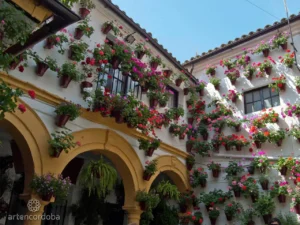
The layout of the patio is irregular, with its walls adapting to the arrangement of the surrounding streets, such as Calle Zarco, which can be accessed from inside. The Cordoban pebble paving contrasts with the white lime of the walls and the green of the abundant and lush vegetation, just like the other patios of the house.
On the left, attached to one of the walls, we find a stone basin into which water pours from a gray marble mascaron inscribed with: “Year 1913, Fountain of Doña Leonor”, referencing a sister of the last marquess.
The left wall is covered with climbing lantanas, while the decoration of this patio is completed with red and purple bougainvillea, rose bushes, and a wide variety of jasmine. As in other patios, there is no shortage of old jars, flowerpots, and other archaeological remnants.
🌸 Blooming calendar
| Species | Jan. | Feb. | Mar. | Apr. | May | Jun. | Jul. | Aug. | Sep. | Oct. | Nov. | Dec. |
|---|---|---|---|---|---|---|---|---|---|---|---|---|
| Bougainvillea | ● | ● | ● | ● | ● | ● | ● | |||||
| Chrysanthemum | ● | ● | ● | |||||||||
| Jasmine | ● | ● | ● | ● | ● | ● | ● | ● | ● | ● | ● | ● |
| Petunia | ● | ● | ● | ● | ● | ● | ● | |||||
| Verbena | ● | ● | ● | ● | ● | ● | ● | ● | ● | ● | ● | ● |
| Spanish flag | ● | ● | ● | ● | ● | ● | ||||||
| Sun plant | ● | ● | ● |
Visit to the Patio del Pozo
If you’re wondering what to visit in Córdoba, a great option would be the Palacio de Viana, by choosing one of our guided tours. This way, you’ll get to know everything about the Patio del Pozo. Choosing quality tourism means choosing ArtenCórdoba.
Text: J.A.S.C.


