


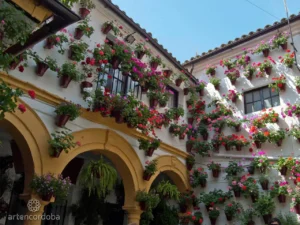




The next stop features the Patio de los Naranjos of the Viana Palace. It takes its name from the six century-old orange trees that surround its central fountain.
The courtyard has a trapezoidal shape; on its shorter side, there is a small square pond with five spouts, decorated with blue ceramic motifs and wirework. Across the rest of the surface, flowerbeds filled with abundant ribbon plants stand out, especially those located along the enclosure wall.
Historical evolution of the courtyard
In one of the 19th-century plans that still survives, the Patio de los Naranjos appears divided into two clearly distinct areas: the pond zone, which had various names over time such as Fountain Courtyard, Drinking Courtyard, or Vine Courtyard; and the orange tree zone, which was known as the Dining Rooms Courtyard, in reference to the palace rooms that overlooked the enclosure. We don’t know when the wall separating them was torn down, but by the time of the last Marquises of Viana, it no longer existed.
Vegetation and ornamental elements
From the flowerbeds arise climbing plants that cover much of the walls, such as the wisteria, which almost entirely covers the end wall. In one corner grows the fragrant heliotrope, with its small bluish flower said to be the marquis’s favorite plant. The central fountain, which has an octagonal shape, is covered with pots full of ox-tongue and water lilies. Bougainvilleas, blue plumbagos, clivias, rosebushes, lantanas, geraniums, and trailing geraniums are also abundant.
Architecture and sensations of the space
The palace façades merge with the plant composition to form a unique setting. There are up to four openings on the upper floor, two of them part of a corner balcony, and the other two, wrought iron balconies. On the ground floor, three doors from three different rooms open into the Patio de los Naranjos, two of them aligned with the balconies above. The woodwork features the familiar bluish tones.
The constant sound of the fountain’s spouts, the dim lighting, and the need to explore each corner due to its non-overviewable layout fill this beautiful space with mystery, solitude, intimacy, and tranquility… making it a matchless setting.
Visit the Patio de los Naranjos
If you’re wondering what to visit in Córdoba, a great option would be the Viana Palace, by choosing one of our guided tours. This way, you’ll learn everything about the Patio de los Naranjos. Choosing quality tourism means choosing ArtenCórdoba.
🌸 Blooming Calendar
Blooming calendar of the main species inhabiting the Patio de los Naranjos
| Species | Jan. | Feb. | Mar. | Apr. | May | Jun. | Jul. | Aug. | Sep. | Oct. | Nov. | Dec. |
|---|---|---|---|---|---|---|---|---|---|---|---|---|
| Orange tree | ● | ● | ● | ● | ● | ● | ||||||
| Water lily | ● | ● | ● | ● | ||||||||
| Heliotrope | ● | ● | ● | |||||||||
| Calla lily | ● | ● | ● | |||||||||
| Wisteria | ● | |||||||||||
| Ox-tongue | ● | ● | ● | |||||||||
| Blue plumbago | ● | ● | ● | ● | ● | ● | ||||||
| Calla lily | ● | ● |
Text: J.A.S.C.


