


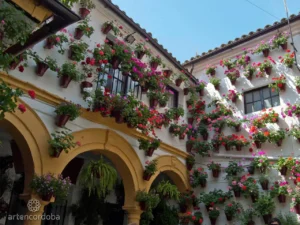




The Patio de la Cancela gets its name from the large iron gate that closes off its only wall open to the outside. It is the only patio, along with the Patio de las Rejas, that can be viewed from outside.
It belonged to the houses of the Marquises of Torres Cabrera; in fact, it was their reception patio, the one that provided access to the entire complex. This function has recently been restored, as the entrance to the Palacio de Viana is now through its fantastic gate.
Patio Architecture
The space is rectangular, with two galleries featuring porticos, specifically on the two longer sides. The porticos open outward through semicircular arches on the ground floor; on the first floor, the same layout is maintained, but the semicircular arches are replaced by flat lintelled openings topped with split triangular pediments. The difference lies in the fact that the arches of one of the porticos are supported by chamfered pillars, while those of the other rest on brick pilasters that are part of the wall.
Decorative Elements
The floor of the Patio de la Cancela is made of the typical Cordoban pebble mosaic, arranged in black and white grids, and it is centered around the usual fountain, finely designed, which was originally a baptismal font.
The walls are covered with climbing plants, bougainvilleas, and miniature roses. Ivy climbs the pillars of the façade, and in the flowerbeds, there are geraniums, calla lilies, and ficus. A beautiful specimen of yew tree grows next to one of the pillars. The plant is very decorative due to its pyramidal shape.
Historical Remains and Current Use
As in other patios, we find archaeological remains, such as a sculpture of “San Antón” dating from 1678; placed in a niche between Roman column shafts, it seems to watch over anyone walking through the patio. Wooden benches and furniture of style provide an ideal space for contemplation and rest.
If you wish to visit the Patio de la Cancela of the Palacio de Viana, do not hesitate to book one of our guided tours. We are experts in the interpretation of Córdoba’s historical heritage. If you have chosen to enjoy tourism in Córdoba, choose a quality option—choose ArtenCórdoba.
Blooming Calendar
🌸 Blooming Calendar – Patio de la Cancela
| Species | Jan. | Feb. | Mar. | Apr. | May | Jun. | Jul. | Aug. | Sep. | Oct. | Nov. | Dec. |
|---|---|---|---|---|---|---|---|---|---|---|---|---|
| Clivia | ● | ● | ||||||||||
| Miniature Rose | ● | ● | ||||||||||
| Calla Lily | ● | ● | ● | |||||||||
| Bougainvillea | ● | ● | ● | ● | ● | ● | ● | |||||
| Centaurea | ● | ● | ● | |||||||||
| Geranium | ● | ● | ● | ● | ● | |||||||
| Trailing Geranium | ● | ● | ● | ● | ● |
Text: J.A.S.C.


