


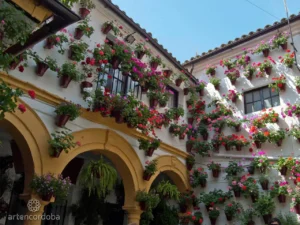




If, in the case of the Patio de las Rejas, we mentioned that it was designed to be seen from the outside as a form of economic and social ostentation, the opposite is true for the Patio de la Madama: it was intended to be viewed from within, in privacy.
The name Patio de la Madama refers to the naiad of the fountain, who in Greek mythology was the nymph of fresh water. The use of such deities in garden design was very common in Roman times, which makes sense; but during the Renaissance, with the renewed taste for the classical, it came back into fashion.
Historical origin of the Patio de la Madama
To trace the origins of this courtyard, we must go back to the 18th century, when the fourth Marchioness of Villaseca, Doña Ana Rafaela Fernández de Mesa, undertook several important works in the palace. Among the most notable were the addition of this very courtyard and that of the Archivo. However, it was not until the early 20th century that the second Marquis of Viana, Don José Saavedra y Salamanca, decided to plant the magnificent circle of cypresses that surrounds the sculpture of the Madama, thus completing the ensemble.
Vegetation and aromas
As for its vegetation, in addition to the aforementioned circle of cypresses, we must highlight the four large and ancient boxwood spheres that frame the space, the mandarin trees, bougainvillea, pansies… and the sweet fragrance that emanates from the gardens covering the walls.
Architecture and layout
The layout of the Patio de la Madama is quadrangular, and the paving is made of flat bricks. The palace windows overlooking the courtyard belong to the Salón de Tobías on the ground floor and the Marchioness’s Bedroom on the upper floor.
As is typical in this building, shafts, columns, and other archaeological remains decorate the courtyard, giving it a unique charm and character. However, the architecture is very simple: two stories, the first featuring openings and windows, and above them, a continuous corner balcony accessed through four doors. The woodwork is painted in the beautiful blue that characterizes the entire palace.
🌸 Blooming calendar
| Species | Jan. | Feb. | Mar. | Apr. | May | Jun. | Jul. | Aug. | Sep. | Oct. | Nov. | Dec. |
|---|---|---|---|---|---|---|---|---|---|---|---|---|
| Mandarin Tree | ● | ● | ● | ● | ● | ● | ● | |||||
| Violet | ● | ● | ● | ● | ● | |||||||
| Pansy | ● | ● | ● | |||||||||
| Bougainvillea | ● | ● | ● | ● | ● | ● | ● | |||||
| Calla Lily | ● | ● | ● | |||||||||
| Senecio petasite | ● | ● | ||||||||||
| Jasmine | ● | ● | ● | ● | ● | ● | ● | ● | ● | ● | ● | ● |
Visiting the Patio de la Madama
If you’re wondering what to do in Córdoba, we recommend visiting the Palacio de Viana by booking one of our guided tours. There, we dedicate a special chapter to the Patio de la Madama. Choose quality tourism with qualified staff—don’t hesitate, ArtenCórdoba is the best option.
Text: J.A.S.C.


