


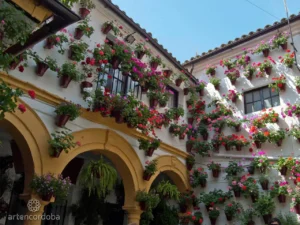




We head to another nearby street to the Mosque-Cathedral, namely Encarnación Street, which owes its name to the former Cistercian cloistered convent, dating back to the 16th century, just like the courtyard we are visiting, according to its owner, the one at Encarnación Street, 11.
History and Family Tradition
Rosario, its owner, inherited the house from her aunt María del Valle Jiménez, whom she remembers fondly, as she was the one who taught her much of what she knows. María del Valle prepared the courtyard every year since the 1960s, and continued to do so until she passed away in 2003, right after one of the annual competitions, Rosario notes.
Courtyard Architecture
A narrow hallway leads us to the small-sized courtyard; however, this is not a disadvantage but rather the opposite, as it brings great freshness and color to the home. The courtyard features an L-shaped portico with semicircular arches resting on columns and pillars painted in yellowish tones. Through this portico, one can access different areas of the house and its upper floor, via a narrow staircase on the right.
Decoration and Unique Elements
It is difficult to enter the interior of the courtyard, as its limited space is completely covered with flowerpots, all in greenish tones and containing various types of plants. On the visible portion of the ground, we find it is made of traditional Cordoban pebble paving, bordered at the edges with stones of a different color. At the center, there is a beautiful white stone fountain, with a marble base and shaped like a scallop shell. In May, Rosario usually fills it with water and covers it with pink bougainvillea, creating a spectacular effect in the courtyard.
Next to the fountain, the most striking element of the courtyard is the clay “peineta” composed of two rows of tiles. Rosario tells us that Antonio Gala visited the courtyard in May 2010 and was captivated by the ensemble.
The entire perimeter of the courtyard is covered up to mid-height with tiles forming an elegant geometric design in shades of blue, contrasting with the intense green of the plants and the other colors of the courtyard’s flowers. On the other hand, the windows barely stand out, as they are white with greenish glass, though they provide harmony to the whole and give more prominence to the vegetation.
Visiting the Patios of Córdoba
If you are wondering what to do in Córdoba, we recommend visiting the Patios of Córdoba by booking one of our guided tours. There, we will dedicate a special section to the Courtyard at Encarnación Street, 11. Choose quality tourism with qualified staff—no doubt, ArtenCórdoba is the best option.
Text: J.A.S.C.


