






The building, formerly known as the Hospital de San Sebastián, was constructed between 1512 and 1516 by the architect Hernán Ruiz the Elder, at the request of the Brotherhood of San Sebastián. The site chosen for this work was a plot of land then known as the “Corral de Cárdenas“, located opposite the western side of the Mosque-Cathedral, which is now Calle Torrijos. The plot corresponds to the area that, during the Islamic period, belonged to the ablutions hall located on the west side of the Mosque.
The San Sebastián Brotherhood was overseen by the Cathedral Chapter and had been operating since the mid-14th century. After several changes of location, they decided to establish a new hospital dedicated to the care and treatment of the mentally ill and those with contagious diseases. However, this was not the only function of the hospital, since from the early 19th century it became a center for abandoned children, which is why it was also known as the “House of the Exposed” or “Foundling Hospital“.
Cordoban society was especially sensitive to a problem it had been facing since the mid-16th century: the abandonment of children in the streets and, in many cases, on the banks of the river. For this reason, the brotherhood was founded, and as a temporary measure, one of the wings of the Courtyard of the Orange Trees of the Mosque was adapted for this purpose, which is why one of the entrances is still called the “Postigo de la Leche”.
The founder and his involvement
It was at this time that the wealthy Juan Fernández de Córdoba, known from sources for his dissolute lifestyle, was persuaded by Don Juan de Ávila to sponsor the hospital project. Years earlier, Fernández de Córdoba had repented of his past life and had brought the Jesuits to Córdoba, giving them his own house, which soon became a church, today popularly known as the Church of the Compañía.
Modern history of the building
In 1850, the Hospital de San Sebastián became the property of the Provincial Council of Córdoba, but continued to function as a foundling home and maternity hospital until 1961, when the building was closed for more than two decades. Today, it is home to the city’s Congress and Exhibition Palace; additionally, the former Church houses a Tourist Information Office, so access is free for tourists.
Architecture of the building
Focusing on its formal aspects, the building has preserved much of its original structure, especially the façade, church, and courtyard. However, in terms of artistic style, it belongs to a period of aesthetic and intellectual transition, blending Gothic, Mudejar, and even Italian Renaissance elements.
The church
The church has a rectangular hall-type floor plan divided into two sections: the oratory and the presbytery. Two aspects of its interior stand out: first, the Gothic ribbed vault over the presbytery, which rests on infill panels; and second, the galleries on the sides of the church, from which the hospital patients could follow religious ceremonies.
The courtyard
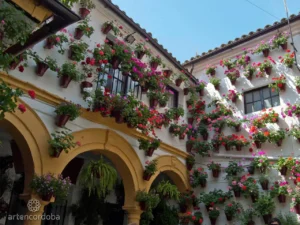
The quadrangular courtyard has two levels of arcades. The ground floor consists of rows of high semi-circular arches, while the second floor features lowered semi-circular arches.
The portal by Hernán Ruiz I
The most remarkable feature of the complex is undoubtedly the portal designed by master Hernán Ruiz I the Elder around 1516. It is very deteriorated by the passage of time, the poor quality of the stone, and, it must be said, institutional neglect; nevertheless, we can still enjoy this exceptional composition decorated with plant and zoomorphic motifs.
We are faced with an entrance consisting of three arches so low they appear almost flat. From the jambs framing the portal springs a blind arch whose moldings simulate an ogee arch, resting above the mentioned entrance opening. The tympanum houses three sculptures under finely decorated canopies, believed to represent Saint Peter, Saint Sebastian, and Saint Paul. More sculptures can be found among the shafts flanking the door and the jambs, all arranged on brackets and covered by delicate canopies. Above the blind arch runs a decoration of interlacing typical of the Gothic style, topped by cresting.
Visiting the Hospital de San Sebastián
If you are wondering what to do in Córdoba, we recommend visiting the former Hospital de San Sebastián by booking one of our guided tours. Choose quality tourism with qualified staff; don’t hesitate, ArtenCórdoba is the best option.
Text: J.A.S.C.
Image Gallery


