


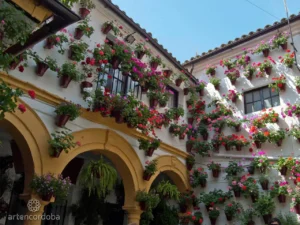




It is said of the Patio de las Rejas that it is one of the few examples in the palace where architecture prevails over botany—and rightly so, as it was conceived to impress, to allow the passerby on the street to glimpse the social and economic status of the family who owned the estate.
To that end, Don Gómez de Figueroa y Córdoba, third Lord of Villaseca, commissioned the works from master builder Bartolomé de los Reyes y Cueto, back in the year 1624. The result was a magnificent exterior façade in Mannerist style, whose main feature was three large openings adorned with wrought iron grilles.
Since its creation, the Patio de las Rejas has always been especially cherished by the various owners who have passed through the palace, knowing that it should always be kept in excellent condition.
Description of the Patio de las Rejas
The Patio de las Rejas has an almost rectangular layout and a floor covered with the typical Cordoban pebble mosaic, arranged in black and white rectangles. At its center stands a circular fountain made of red marble, topped with a bowl and spout. Lined up around the fountain, weathered yellowish stone bases serve as pedestals for pots of maritime cinerarias.
As a backdrop to this magnificent scene, the walls of the patio are almost entirely covered with orange, lemon, and bergamot trees, all pruned in a garden-like fashion—a typical plant styling in our city, which consists of placing the plant next to the wall and then guiding its branches decoratively.
An intriguing tradition
As a curiosity, the Marquises of Viana had the tradition of watching, year after year, the procession of the Virgin of Las Angustias as it passed along Calle Rejas de Don Gome. The Marquises would stand behind the grilles and observe the procession as it went by.
It is said that the float not only paused in front of the grilles but even made a slight turn toward the patio, as a form of reverence. Don José Benítez said: “From ’44 until three years ago, the Marquises came every Holy Week.”
Visit the Patio de las Rejas
If you wish to visit the Patio de las Rejas of the Palacio de Viana, don’t hesitate to book one of our guided tours. We are experts in the interpretation of Cordoba’s historical heritage. If you’ve chosen to do some tourism in Córdoba, choose a quality option—choose ArtenCórdoba.
🌸 Blooming Calendar
Blooming calendar of the main species found in the Patio de las Rejas
| Species | Jan. | Feb. | Mar. | Apr. | May | Jun. | Jul. | Aug. | Sep. | Oct. | Nov. | Dec. |
|---|---|---|---|---|---|---|---|---|---|---|---|---|
| Citrus | ● | ● | ● | ● | ● | ● | ● | |||||
| Geranium | ● | ● | ● | ● | ● | |||||||
| Ivy Geranium | ● | ● | ● | ● | ● | |||||||
| Hybrid Cineraria | ● | ● | ● | ● | ||||||||
| Centaurea | ● | ● | ● | |||||||||
| Calla Lily | ● | ● | ● |
Text: J.A.S.C.


