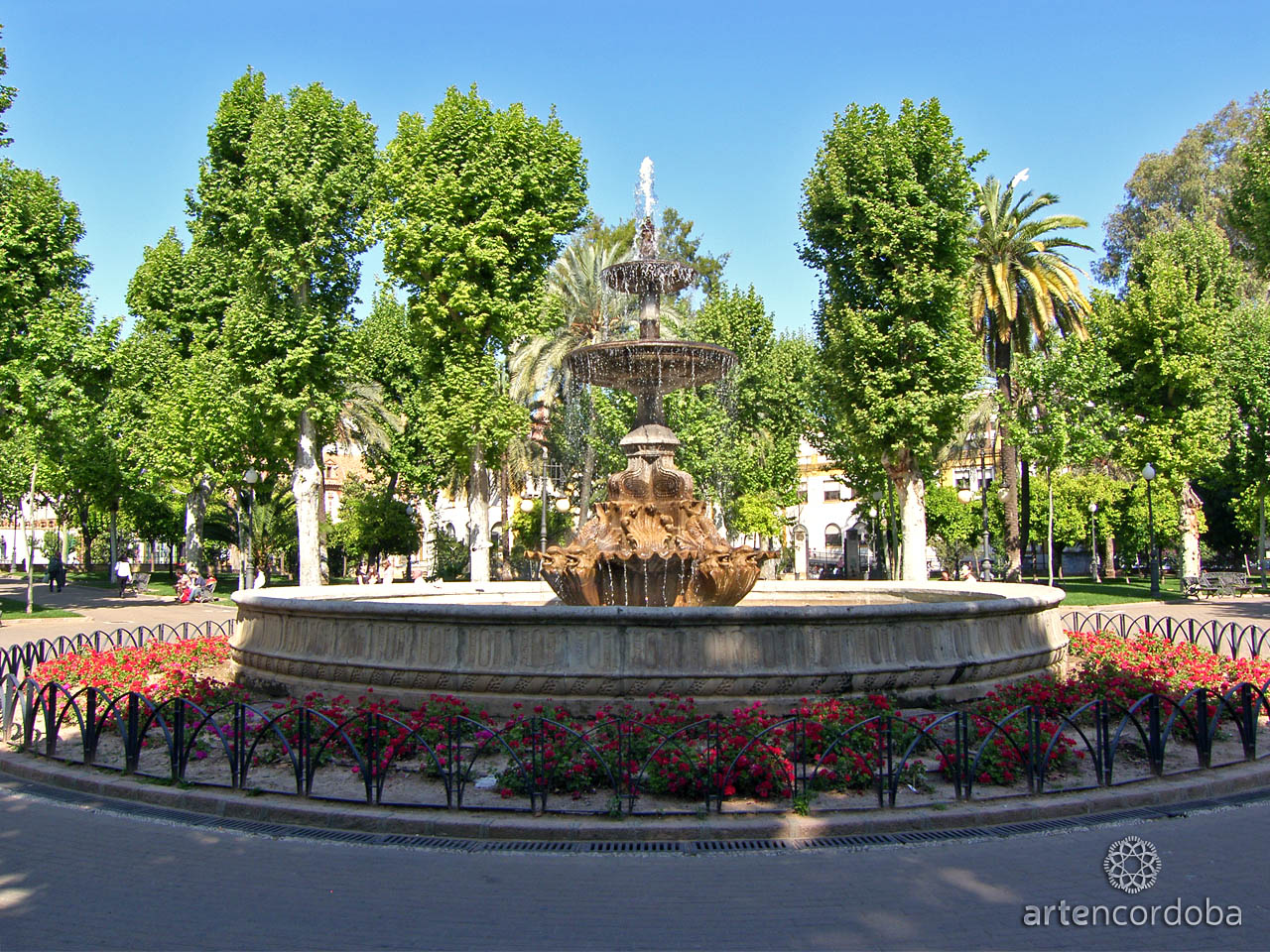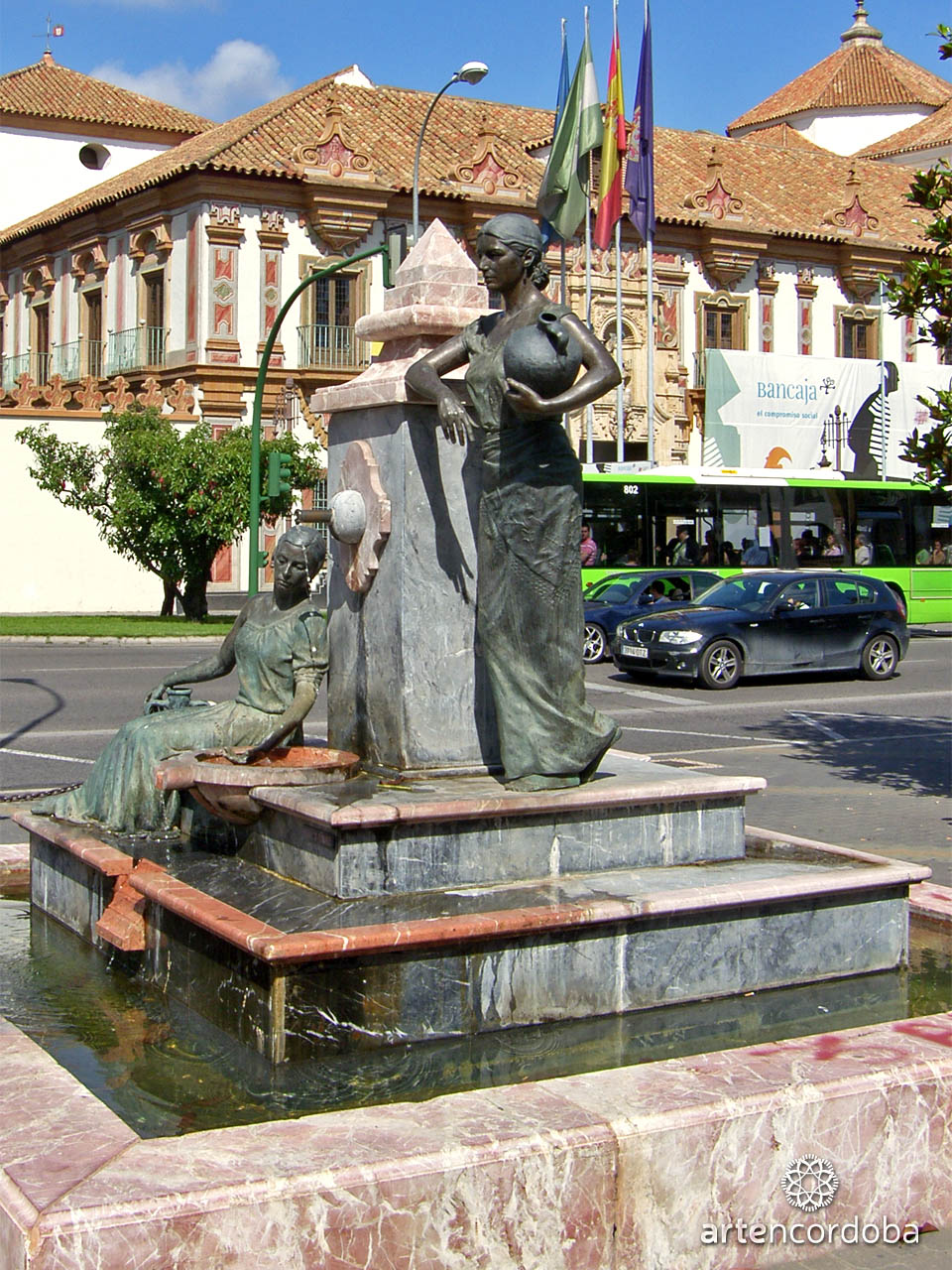






The Plaza de Colón houses within the Jardines de la Merced an oasis in the busy and fast-paced center of Córdoba. It is an island surrounded by a vast sea of modern six- or seven-story buildings, in stark contrast to the medieval Torre de la Malmuerta or the old Mercedarian Convent of the city, now home to the Provincial Council of Córdoba.
Plaza de Colón and its gardens
It is quite difficult to enjoy a full view of the Plaza de Colón, mainly due to the large size of the trees. A certain Cordoban historian used to say they were fertilized by the ashes of Roman patricians who rest in the old Roman cemetery, and he wasn’t wrong; in fact, the name of one of the nearby streets, Calle de Osario, bears witness to this.
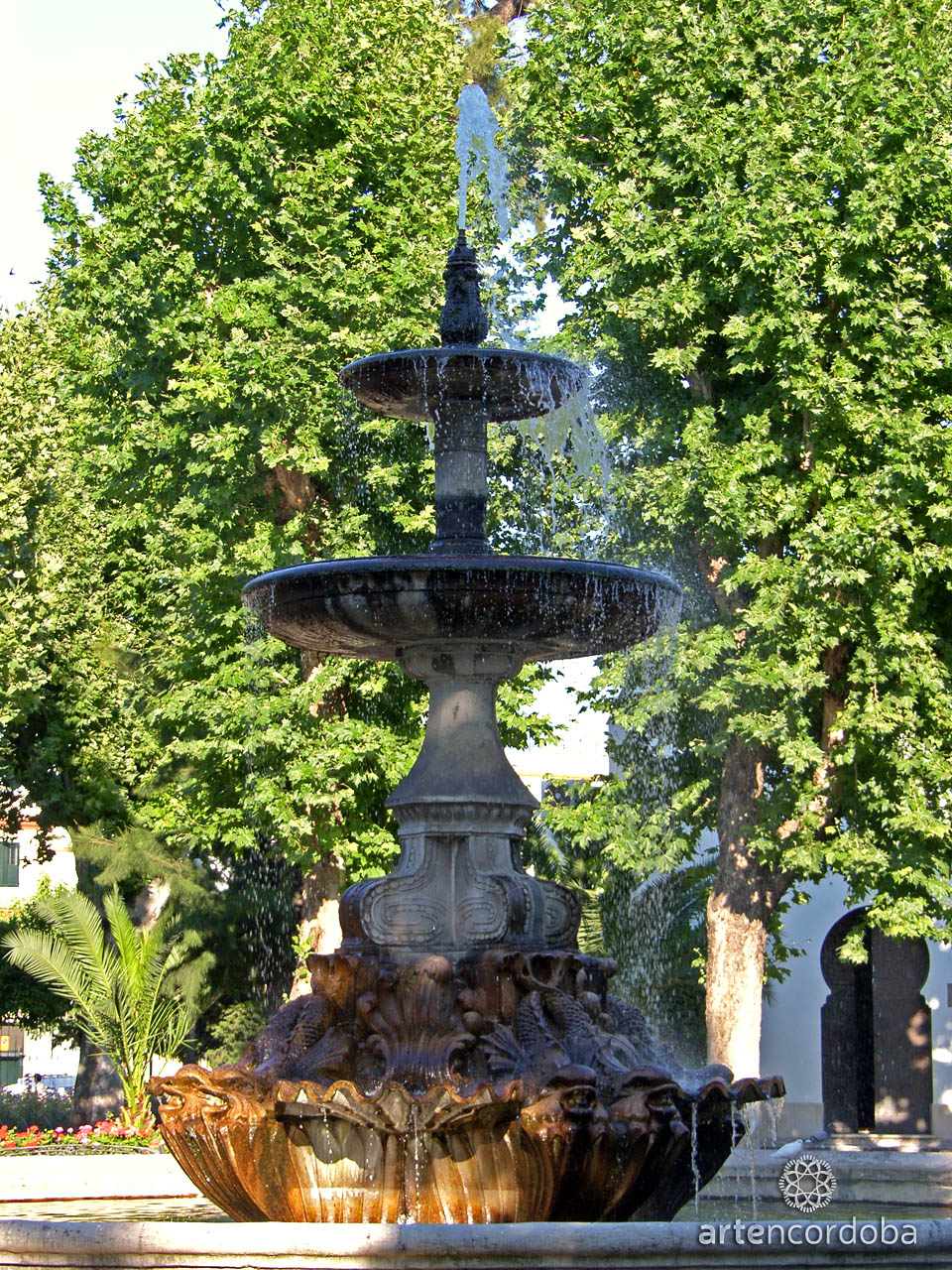
At the center of Plaza de Colón, and thus of the Jardines de la Merced, stands the fountain created by sculptor Rafael del Rosal, following plans by the renowned architect Carlos Sáenz de Santamaría in 1905. On a large circular basin rises the central pillar, decorated with scallop shells, volutes, and various sea creatures, giving this central fountain a very characteristic neo-romantic feel. A dozen cast iron benches surround it in a circle, reminiscent of the bullring that stood here until 1831.
The old Convent of La Merced
But without a doubt, the true highlight of the Plaza de Colón is the façade of the old Mercedarian Convent, which takes us back to the time when Saint Ferdinand reconquered the city in 1236. At that time, the holy monarch founded four convents: San Pablo, San Pedro el Real, now the Parish of San Francisco and San Eulogio, La Trinidad, and the one we’re focusing on, La Merced. The original convent, which no longer exists, is believed to have been founded on the old Hermitage of Santa Eulalia, and tradition says that none other than Saint Peter Nolasco, founder of the Mercedarian Order, attended the inauguration ceremonies.
The poor condition of the convent led Commanders Fray Lorenzo Ramírez and Fray Pedro de Anguita to sponsor its renovation, with work beginning in 1716 and completed in 1745, giving it its current form. After Mendizábal’s fierce confiscation, the convent passed into the hands of the Board of Charity, later becoming an orphanage run by the Sisters of Saint Vincent de Paul, and finally the current seat of the Provincial Council of Córdoba.
Authorship and façade
Many candidates have been proposed by historians as possible authors of the works. Hurtado Izquierdo was a strong contender but, as Don Miguel Ortí Belmonte points out, he died in 1713, shortly before the start of construction. Belmonte suggests it may have been Juan de Aguilar, who at the time was working on the renovation of the Royal Collegiate Church of San Hipólito.
The convent façade, decorated in fresco, features lintelled openings on both floors, separated by painted pilasters, alternating between one and two. The convent door bears the order’s coat of arms on its lintel, and a niche decorated with an image of Saint Peter Nolasco. The church’s portal breaks the horizontal rhythm of the structure, featuring a central entrance in white marble in the Churrigueresque style, where four Solomonic columns on plinths flank the lintelled entrance, also decorated with the Mercedarian coat of arms. In the second tier, the columns are smaller, and between the volutes of a split pediment is a beautiful sculpture of the Virgin of Mercy. The top floor is crowned by a large triangular pediment and topped with a sculpture of the Archangel Saint Raphael. On either side rise two twin bell gables, each with two bell openings.
The church and cloister
The church is located at the center of the complex and serves as the dividing axis between the two cloisters that structure the building. It has a Latin cross layout inscribed in a rectangle, with a flat apse, three naves, and a transept. The central nave is covered by a barrel vault with lunettes, and the arms of the transept by quarter-sphere vaults divided into three segments. The structural elements are decorated with polychrome medallions featuring busts in high relief of the saints and blesseds of the Mercedarian order, framed by rich plasterwork. It has a very large high choir, whose parapet curves to include the now-lost organ tribunes.
The last part to be completed was the main cloister, finished in 1752. Quadrangular in layout, it consists of two floors: the first with a portico of semicircular arches on pairs of Tuscan columns, and a closed second floor, with pilasters decorated with plaques and balconies in between. At the center stands a large black marble fountain. The entire complex is richly decorated.
Visiting Plaza de Colón
If you’re wondering what to visit in Córdoba, a good option would be the Plaza de Colón and the Jardines de la Merced, choosing one of our guided tours. Choosing quality tourism means choosing ArtenCórdoba.
Text: J.A.S.C.