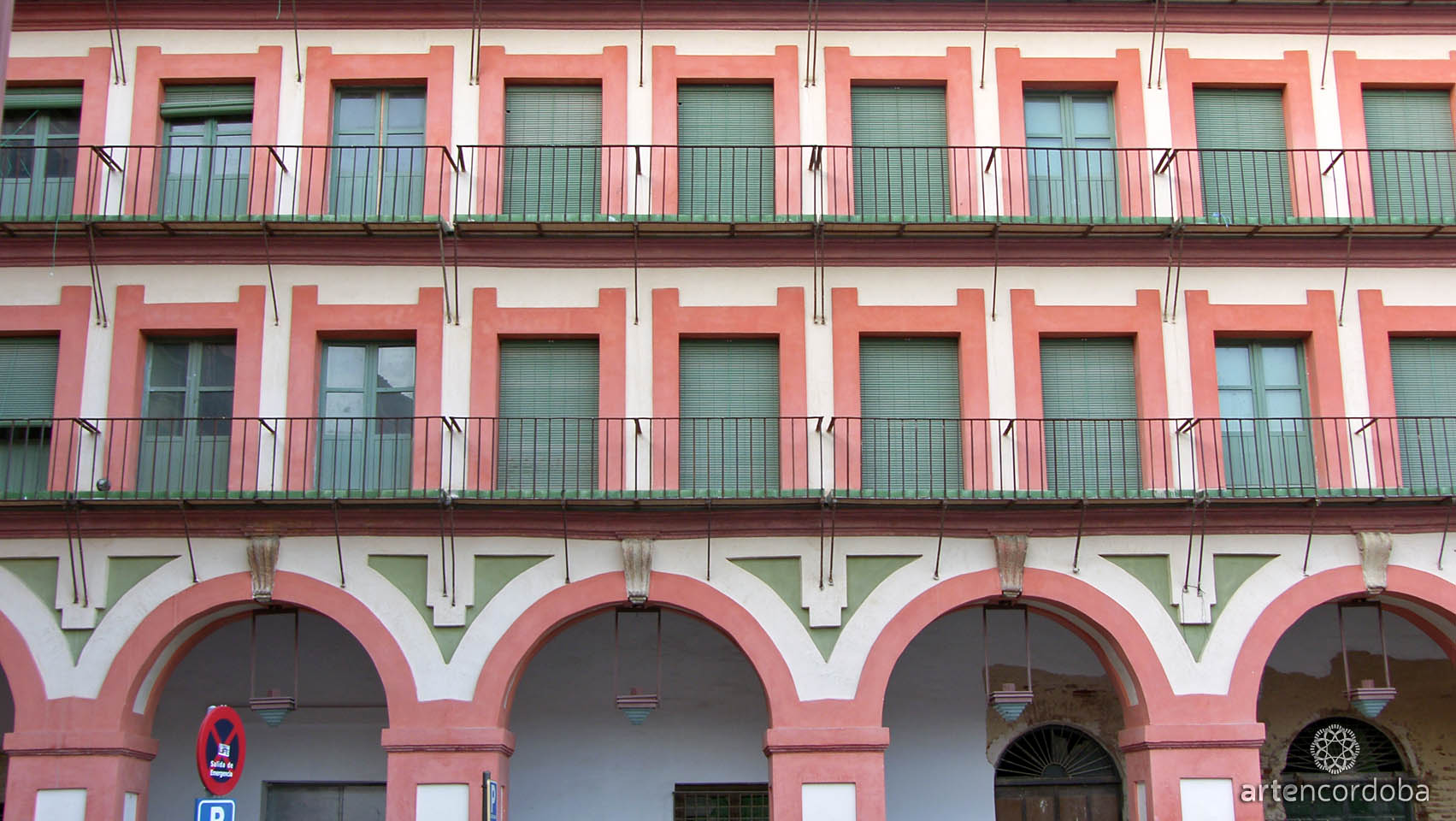






The current configuration of the Plaza de la Corredera is the result of works carried out between 1683 and 1687 by the Magistrate Don Francisco Ronquillo Briceño. These were prompted by the near collapse of one of the wooden grandstands, which were then installed during the bullfights held in the plaza, and which caused panic among those present.
The works consisted of the construction of the façade galleries, as well as the arcades on the ground floor and balconies on the three remaining levels. The aim was to beautify an architecturally irregular environment by aligning its façades and, as mentioned, improving the safety of public events. The works, not without significant challenges, were funded through financial contributions from local residents, festivities, or loans.
The Plaza de la Corredera is one of the few Castilian-style squares in Andalusia, a very popular spot in Córdoba.
Preserved historical buildings
The remodeling of the Plaza de la Corredera, far from being comprehensive, did not affect two buildings on the southern side: the Magistrate’s Residence and Jail, which was preserved for its artistic value, and the House of Doña Jacinta, as it was then known, both of which still remain.
The Magistrate’s Residence, a Mannerist-style building believed to be the work of the Cordoban architect Hernán Ruiz III, was built between 1583 and 1586. The jail, which was then located in the basement, remained there until 1821, when it was moved to the Christian Alcazar. In the 1940s, the City Council sold the building to businessman José Sánchez Peña, who converted it into a hat factory, and later it became a market.
The other building that was not affected by the remodeling was the House of Ana Jacinto de Angulo (Doña Jacinta), who vehemently opposed the demolition of her home to expand the plaza, even managing to obtain a royal decree from King Charles II in her favor. It is located in the southwest corner of the square and consists of three stories with rows of small balconies separated by smooth-shafted columns with Tuscan capitals.
The Corredera Market
José Sánchez Muñoz, son of businessman José Sánchez Peña, had been running the market located in the basement of the old jail since 1882, when he came up with the idea of creating a large covered market in the center of the square. With the help of French capital, he reached an agreement with the City Council granting him exploitation rights for 50 years, and the market was inaugurated in August 1896.
The Plaza de la Corredera remained the city’s main market until 1946, when the rights expired, and the facilities remained until 1959, when they were demolished. To replace the market, Mayor Antonio Cruz Conde ordered the construction of an underground one, whose excavation led to the discovery of numerous Roman-era mosaics, most of which are now exhibited in the Mosaic Hall of the Christian Alcazar.
Architectural evolution
After the market was demolished, architect Víctor Escribano Ucelay removed the plaster from the façades, leaving the brickwork exposed, believing this was their original state. However, with the most recent intervention by Juan Cuenca Montilla, the plaza has been re-plastered and painted in soft shades of red, green, and ochre, returning to the scheme it is believed to have had in the 17th century. Don Miguel Ortí Belmonte used to say that back then, red tones were achieved using the blood of bulls killed during the bullfights, which gave the plaza great artistic value.
History and celebrations
The Plaza de la Corredera has hosted countless celebrations throughout its long history, such as the one held in 1571 to celebrate the victory at Lepanto against the Turks. Ramírez de Arellano tells us how a real naval battle was staged in the square, with several boats firing rockets at each other.
The most frequent shows were, without a doubt, bullfights, from which its name derives. Notable figures such as King Philip IV and Cosimo de’ Medici witnessed major bullfights held in the plaza. However, not all events were celebrations, as the Corredera was also the site chosen by the Inquisition to hold its autos-da-fé. The gallows used by the French in the early 19th century to execute those sentenced to death was also located here.
Visiting the Plaza de la Corredera
If you would like to visit the Plaza de la Corredera, don’t hesitate to book one of our guided tours. We are experts in the interpretation of Córdoba’s historical heritage. If you have chosen to go touring in Córdoba, choose a quality option — choose ArtenCórdoba.
Text: J.A.S.C.