






History of the Alcázar of the Christian Monarchs
The Alcázar of the Christian Monarchs has played the role of a political power center since its origins. In Roman times, it served as the customs headquarters and residence of the officials governing the city: the Procurator and the Quaestor. During the Visigothic period, the building continued to be used without significant modifications.
The situation changed with the Muslim invasion. During the emirate period, Abd al-Rahman I and his successors Al-Hakam I and Abd al-Rahman II expanded the building with new channels, gardens, and stables, adapting it to the Andalusi lifestyle. With the foundation of the independent Caliphate in the 10th century by Abd al-Rahman III, the Alcázar lost importance in favor of the palatine city of Medina Azahara, and in later centuries it suffered looting that led to its deterioration. Even so, blocks, columns, and capitals from the Roman era, as well as Visigothic and Islamic elements, are preserved.
Successive cultures in Córdoba’s history have left their mark on the Alcázar of the Christian Monarchs.
The Alcázar after the Christian conquest
After the conquest of Córdoba in 1236, Ferdinand III the Saint distributed the land of the old Andalusi Alcázar among the bishop, the nobility, and the Order of Calatrava. His son, Alfonso X the Wise, began work to transform it into a royal residence. In the 14th century, Alfonso XI ordered its fortification between 1327 and 1329. He lived there with Leonor de Guzmán, where they had ten children, including Henry II of Trastámara.
The Alcázar was also the setting for episodes of the civil war between Peter I the Cruel and Henry II. After the conflict, Henry II reclaimed the building as a royal residence from 1371. His grandson Henry III the Sufferer also resided there — welcomed in 1395 — as did Henry IV, who departed from the Alcázar in 1455 for his wedding to Joan of Portugal, mother of Joanna la Beltraneja.
The Catholic Monarchs and Christopher Columbus
From 1482, the Catholic Monarchs used the Alcázar as their headquarters, and from here they organized the conquest of Granada, completed in 1492. It was also the place where they first received Christopher Columbus in 1486. In the Alcázar, Princess Doña María was born, future Queen of Portugal and grandmother of Philip II.
In 1499, the monarchs ceded the building to the Tribunal of the Inquisition. The Alcázar was then transformed to house dungeons and cells, losing its palatial character.
From the Inquisition to contemporary restoration
For more than three centuries, the building functioned as the headquarters of the Inquisition, until the abolition of the Holy Office in 1812 and its definitive dissolution in 1821. Between 1821 and 1931, the Alcázar was used as a civil and later military prison. It came to include 33 rooms, 20 cells, and 7 courtyards.
In 1931, it was declared a Historical Monument, although its deterioration was significant. In 1955, Mayor Antonio Cruz Conde secured its transfer to the City Council and entrusted its restoration to Víctor Escribano Ucelay. One of the highlights of this work was the decoration of the main hall with Roman mosaics found in the Plaza de la Corredera. The Gardens of the Alcázar have had special protection since 1986 and, in 1994, the complex became part of the UNESCO World Heritage Site.
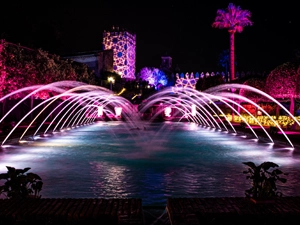
The Alcázar of the Christian Monarchs has served many functions throughout its history; today it hosts weddings, concerts, and cultural activities.
The old palace has regained its splendor, located very close to the Mosque-Cathedral. Today it hosts exhibitions, concerts, and weddings. A modern inscription reminds visitors that, according to tradition, Gaius Julius Caesar planted an oriental plane tree here — a testament to the legacy of the different cultures that have shaped the history of Córdoba in this emblematic building.
If you’re unsure what to do in Córdoba, we recommend visiting the Alcázar of the Christian Monarchs by booking one of our guided tours. We will place special emphasis on the history of the building. Choose quality tourism with qualified staff. ArtenCórdoba is the best option.
Since Roman times, the Alcázar de los Reyes Cristianos served as a center of political power, being the seat of the customs and the residence of high-ranking officials such as the Procurator and the Quaestor.
During the emirate, the building was expanded with gardens, stables, and irrigation systems by Abd al-Rahman I and his successors, adapting it to the Andalusian lifestyle.
After the conquest of Córdoba in 1236, the Alcázar was divided among the Church, the nobility, and military orders. Alfonso X transformed it into a royal residence, and Alfonso XI fortified it between 1327 and 1329.
Since 1482, the Alcázar served as the headquarters of the Catholic Monarchs, where they planned the conquest of Granada and received Christopher Columbus for the first time in 1486.
After the abolition of the Inquisition in 1821, the Alcázar was used as a civil and military prison until 1931. It was then restored and converted into a cultural space, declared a Historic Monument.
Table of contents
Popular visits
Guided Tour Mosque of Cordoba
From:
Guided Tour to Medina Azahara
From:
Guided Tour to the Alcazar of Cordoba
From:
