




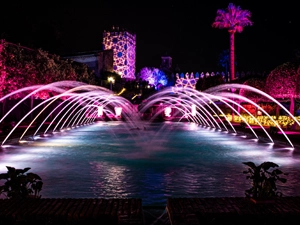


The medieval construction of the Alcázar was almost entirely destroyed after the building was adapted into a prison in the 19th century. It is an exceptional example of a distinctly Muslim layout, of the Morisco type, rectangular, known in Christian Andalusia thanks to the Almoravids. Its corridors form a central cross, at the intersection of which stands a domed fountain with a spout. At both ends, on the shorter sides of the rectangle, there are two shallow pools, with small steps and water spillways.
The Layout of the Morisco Courtyard
The layout of the Morisco Courtyard allows for up to four garden plots, lower in height than the corridors. In each section, one can see orange trees, lemon trees, pomegranates, laurel… gardens with a marked oriental influence coming from Persia. It is believed that the plantations were created and maintained by local people, likely advised and directed by Muslims from Granada or Seville.
Decoration and Architectural Elements
Attached to walls and old rooms, a stucco baseboard runs along, decorated with two distinct types of geometric and Arab lattice designs, using only red, black, and ochre. The main motifs are the coats of arms of León and Castile.
Architecture and Boundaries of the Courtyard
On the eastern side, the Morisco Courtyard borders a structure built in the 19th century to provide the prison with suitable cells. On the northern side stands a façade with a long vaulted gallery, presented to the outside with semicircular arches.
The courtyard is bordered on its western side by a wall crowned with battlements, which connects the Towers of the Lions and of the Inquisition. In the middle of the wall, a sealed access opening can be seen, featuring a slightly pointed arch of Arab origin, as well as a large gate that connects with the gardens of the Alcázar.
Archaeological Remains
A small column is preserved in the courtyard, found during the excavation carried out in 1951. It commemorates the ancient Roman buildings located beneath these grounds, such as the Customs House or the Palaces of the Procurator and Quaestor. The column retains its base, part of the shaft, and the capital, which is heavily eroded.
Visit the Morisco Courtyard
If you wish to visit the Alcázar of the Christian Monarchs and its Morisco Courtyard, don’t hesitate to book one of our guided tours. We are experts in the interpretation of Córdoba’s historical heritage. If you have chosen to go touring in Córdoba, choose a quality option: choose ArtenCórdoba.
Text: J.A.S.C.


