






As it could not be otherwise, the heart of our city, the Plaza de las Tendillas, had to be included in this section on places of interest, as a place for strolling, gathering, celebrating, and even protesting—in short, as a true reflection of what Córdoba is today.
In the center of Córdoba we find the Plaza de las Tendillas
To learn about the beginnings of the Plaza de las Tendillas, we must go back to the early 20th century, when Don José Cruz Conde was the mayor of the city. It was then, in 1924, that the decision was made to demolish the old Hotel Suizo, which Teodomiro Ramírez de Arellano once described as “one of the finest inns in Spain.”
With the demolition of the building—named so because its builders, the Puzzini brothers, were Swiss—a large open space was revealed. Little by little, buildings were added to it, most of which still stand today. In this way, in 1926, on the western side of the plaza, the houses of Martín Fernández, designed by Enrique Tienda Pesquero, and Casana Diéguez, designed by the well-known architect, conservator, and archaeologist Félix Hernández Giménez, were built.
Not even a year later, construction began on the Unión y el Fénix and Telefónica buildings, located on the northern side of the Plaza de las Tendillas, designed by architects Benjamín Gutiérrez Prieto and Ramón Aníbal Álvarez, respectively. In 1928, the southern side was developed: the house of the Counts of Colomera, also designed by Félix Hernández, and that of Enrique Barrios, by Aníbal González; both are considered among the most interesting examples of historicist architecture in our city.
The plaza was enclosed by the Provincial Institute Luis de Góngora, which had stood there since 1847, and where the author of this text was a student not long ago.
However, the distinctive feature of the Plaza de las Tendillas, its icon, is not any of these unique buildings, but rather the beautiful equestrian statue of Don Gonzalo Fernández de Córdoba, popularly known as El Gran Capitán. Created in 1920 by the Cordoban sculptor Mateo Inurria Lainosa, it was initially located on the Avenida del Gran Capitán before being moved to the Tendillas in 1927.
Inurria, who took several years to receive payment for his work, was awarded the medal of honor at the National Exhibition of Fine Arts in 1920. Legend has it that the head came from an old statue of the bullfighter Rafael Molina El Lagartijo, but this is unfounded, as Inurria himself sculpted a bust of the bullfighter, which is housed in the Museum of Fine Arts, and the facial features do not match at all.
The most famous features of Córdoba’s Plaza de las Tendillas
The most well-known features of the Plaza de las Tendillas in Córdoba are the statue of the Gran Capitán and the Clock, inaugurated in 1961, whose chimes replace the traditional bells with flamenco *soleares* chords, recorded by flamenco guitarist Juanito Serrano.
It has become a tradition for the New Year’s Eve grape celebration to be televised from our city, with thousands of Cordobans gathering every year in the plaza, eating the twelve grapes—one for each of the last twelve seconds of the year—to the sound of the clock’s unique melody.
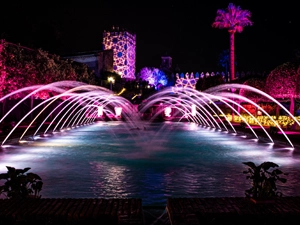
The renovation carried out a few years ago, which relieved the Plaza de las Tendillas of all traffic except on its western side, removed the small landscaped pond that once surrounded the statue, replacing it with a new fountain characterized by a prevailing sense of sobriety.
Square in shape, it contains a circular basin in which the pedestal supporting the statue is placed. On either side, there are two groups of jets, each consisting of sixteen vertical water streams, which become a constant source of play for children, especially in summer.
If you wish to discover the Plaza de las Tendillas, do not hesitate to book one of our guided tours. We are experts in the interpretation of Córdoba’s historical heritage. If you have chosen to go sightseeing in Córdoba, choose a quality option—choose ArtenCórdoba.
Text: J.A.S.C.


