


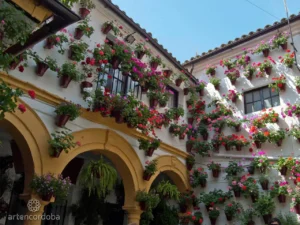


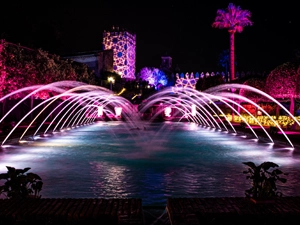


The Fair of Our Lady of Health has its origins in 1284, the year in which King Sancho IV granted the privilege to the Council of Córdoba to hold two annual livestock fairs, one at Pentecost and the other during Lent, each lasting fifteen days. In 1422, the Pentecost fair began to be held in the early days of May. Later, the Catholic Monarchs reaffirmed the celebration of both fairs, and in 1556, Philip II ratified the royal privilege granted two centuries earlier by Sancho IV himself.
Origin of the Fair of Our Lady of Health
In fact, the fair began to be called Our Lady of Health in 1665, the year in which two farmers found the image of a small Virgin in a well located in front of the Seville Gate, whose waters were said to restore health to all the sick who drank them. To commemorate the discovery, a small hermitage was built at that spot and it was transformed into a fair, held in the early days of Pentecost.
Changes of location and historical evolution
In 1790, the fair hours were limited to 10 p.m. by Royal Order, due to disturbances reported at the event. In 1803, the fair was moved in front of the Gallegos Gate, as there was an intention to bring it closer to the bullring in the Campo de la Merced; however, its final location would be the Victoria Gardens starting in 1820.
In 1895, the Brotherhood of Farmers requested that the fair be moved to May 25, and although the petition was approved, it did not become standard until 1905, continuing to the present day. At the beginning of the 20th century, important events took place during the fair, such as the Regional Exhibition of Industry and Art in 1904, or the First Aviation Demonstration performed by René Barrier and René Simón in 1910.
The May Fair in the 20th Century
Coinciding with the appointment of José Cruz Conde as mayor in 1924, electricity was used for the first time in the May Fair, and the first private booths appeared. That year’s chronicle reads: … thousands of lamps with colored paper shades, hanging from cords, crossed all the walkways in every direction, like garlands of luminous flowers, giving it a truly fantastic appearance.
In 1934, Jiménez Lora wrote in El Comercio de Córdoba: … on the plain where the gardens of the Duke of Rivas now stand, amusement stalls, fritter stands, and a long row of booths selling toys, sweets, and jewelry were set up, also extending along the other sidewalk of Paseo de la Victoria (…) The Gallegos Gate was decorated in a colorful and artistic way, and at night, the lighting—less splendid than today—bathed the area in a somewhat twilight and poetic tone of a serene Andalusian night under the full moon of blooming May…
The following year, the director of El Comercio de Córdoba wrote: … Market mornings with their typical scenes of haggling, trickery, and Gypsy wit; a parade of prancing horses, decorated carriages, stately automobiles, flamenco riders, horsewomen wearing the traditional Córdoba hat, showy mares from Cañero, bustling stalls and all the noisy hubbub of the fairground (…) The “botijistas” – visitors arriving in the city by train in special “botijo trains” – crowd the promenades; there is talk of bulls and bullfighters (…) This is not the placid and serene Córdoba of Seneca nor the discreet one of Baroja, it is the boiling, passionate, and Andalusian city that transforms, as if by magic, during these days, injecting into its veins the virus of vertigo and the sap of joviality and joy…
Booths, posters and fairground
The booths of the May Fair are simply meeting places which, traditionally, are mostly set up by Holy Week brotherhoods, social clubs, associations, student faculties, and public institutions.
On the other hand, the tradition of creating fair posters goes back more than a hundred years, as at the end of the 19th century the City Council encouraged contemporary artists to participate in a poster design contest, with renowned artists such as Julio Romero de Torres taking part.
In 1994, after multiple proposals, it was decided to definitively move it to the El Arenal Fairground, a location that offers visitors something the old city venues lacked: space. We Cordobans can proudly say we have a fairground that meets the needs of the event.
Visiting the Fair of Our Lady of Health
If you would like to visit the Fair of Our Lady of Health, don’t hesitate to book one of our guided tours. We are experts in the interpretation of Córdoba’s historical heritage. If you have chosen to do tourism in Córdoba, choose a quality option—choose ArtenCórdoba.
Text: J.A.S.C.


