






To learn about the origins of the Jewish Quarter, we must go back to Roman times, especially to the years when Córdoba held the status of a Colonia Patricia. It was from the era of Augustus onward that the city’s walled perimeter was extended to the south, and thus, the area now occupied by the Jewish Quarter began to be organized and urbanized.
In the 6th century, a marked process of urban renewal took place in the area, as a result of the establishment of political and religious power, previously located in the north of the city. The construction of a Civil Palace on the site where the Episcopal Palace stands today, together with the remains of the Byzantine temple found in the Santa Clara Convent, or the remains of the Basilica of San Vicente located beneath the original Mosque of Emir Abd al-Rahman I, speak of the vast political-religious complex situated in the southern part of the city.
Streets and Squares of the Jewish Quarter
The current Jewish Quarter is made up of the streets: Judíos, Averroes, Tomás Conde, Manríquez, Almanzor, Romero, Deanes, and Judería, as well as the squares of Maimónides, Tiberíades, Judá Leví, and Cardenal Salazar.
The Jewish Quarter in Medieval Times
After the conquest of Córdoba by the Muslims in the year 711, the area continued to be of great importance, as it housed many public buildings and the residential zone. However, it was not at this time that Jews began to settle there, since the Jewish Quarter was then located in the northern part of the Medina, but rather during the late medieval Christian period.
This fact is directly related to its proximity to the Christian Alcázar, as it was under the protection of the crown that Judaism developed in Spain. From then until their expulsion by the Catholic Monarchs, Jews occupied the neighborhood that we now know as the Jewish Quarter.
The boundaries of the Jewish neighborhood were not exactly the same as today; for example, the Jewish Quarter occupied part of the Alcázar Viejo (San Basilio neighborhood), with the Jewish cemetery located to the north of this area, occupying what is now the Dr. Fleming zone.
Today, the Jewish Quarter is roughly bounded by the streets Judíos, Averroes, Tomás Conde, Manríquez, Almanzor, Romero, Deanes, and Judería, and the squares of Maimónides, Tiberíades, Judá Leví, and Cardenal Salazar.
State of Conservation
The truth is that we should celebrate the good state of conservation in which the Jewish Quarter as a whole has reached us; however, there are many aspects that detract from it, such as the constant trickle of cars driving through its streets, or the shop stalls—especially on Calle Deanes—which deprive it of that ancient residential character.
Emblematic Squares
At the heart of the Jewish Quarter is Plaza de Maimónides, known in the 16th century as Plaza de los Armentas for being home to the house of such an illustrious family, later called Plaza de las Bulas or also Plaza del Arcediano, in short, a historic enclave among so many in our city.
Today, it houses the headquarters of the city’s Bullfighting Museum, which is currently under renovation.
Plaza de Tiberíades is smaller than the previous one, but no less attractive. It features a magnificent sculpture by Mateo Ruiz de Olmos representing the Cordoban philosopher Musa Ibn Maymun, or, in other words, Maimónides.
Often enlivened by Cordoban musicians who come to perform their melodies, it has become one of the most evocative and visited places in the city.
Streets of the Jewish Quarter
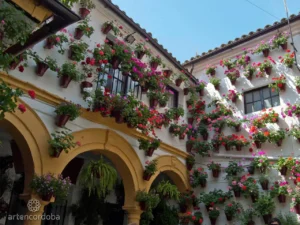
The streets of the Jewish Quarter display two clearly defined axes: the first consists of Judíos and Tomás Conde streets, which run parallel to the old wall; the second is formed by Almanzor and Romero streets.
Between these two axes is a network of winding and narrow streets, some dead ends, owing much to the medieval Islamic urban planning developed in our city.
Of special interest is Calle Judíos. As soon as we enter, we are seduced by the aroma wafting from the wines of the Taberna Guzmán, which invite us to enjoy a friendly chat over a fine local sherry.
Further along, the Casa Andalusí transports us with its music and scents to medieval Córdoba. We arrive at the Synagogue, the temple, the Municipal Souk, the market…
As a Cordoban historian once said: “Haste must be left outside the walls; time stops on Calle Judíos, whose name preserves the echo of distant Sephardic footsteps on the way to the old synagogue.”
Guided Tours of the Jewish Quarter of Córdoba
If you would like to discover the Jewish Quarter of Córdoba, don’t hesitate to book one of our guided tours. We are experts in the interpretation of Cordoban historical heritage.
If you have chosen to do tourism in Córdoba, choose a quality option, choose ArtenCórdoba.
Text: J.A.S.C.


