


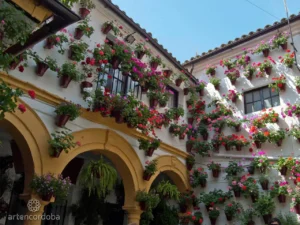


The house at 8 Aceite Street is the result of intense and consistent work over many years, during which José Antonio Espinosa and his wife Carmen have managed to transform a rundown tenement into what we enjoy today—one of the most complete and most visited courtyards during the contest.
José Antonio, a construction professional and lifelong resident of the Santiago neighborhood, acquired this 600-square-meter plot in the 1980s with the aim of renovating it and eventually living there with his family.
The Three Courtyards of the House
The house features three courtyards, each with its own name, in order: Patio de los Chinos, Patio de las Orzas, and Patio del Jardín or de la Piscina. Each has its own unique character—let’s get to know them.
Patio de los Chinos
The first courtyard is known as the Patio de los Chinos, named so because its floor is made of the typical Cordoban pebble mosaic, so popular in this region. The walls of old brick and archaeological remnants on the cornices stand out. In the center, we find a fountain surrounded by plants. Additionally, there are two cypresses that decorate it along with flowerpots on the walls containing daisies, gitanillas, geraniums, and calla lilies.
Patio de las Orzas
Next, we come to the courtyard of the orzas, which seems to follow more closely the standards of the traditional Cordoban courtyard. However, what stands out are the yellow flowerpots, instead of the more common red or blue, though the flowers remain the same, with gitanillas and geraniums being predominant. This courtyard also features a cypress, a basin full of fish, and a door covered by a small tiled roof.
Patio del Jardín or de la Piscina
The third and final courtyard is the garden or pool courtyard. It might have once been the old kitchen, as there is an old stove adorned with antique jars and clay pots, giving it a beautiful sense of the past. Besides the typical plants, a lemon tree stands out. Unlike the other two courtyards, this one breaks all the rules of the classic courtyard, bordering on vegetative and architectural anarchy. We access the garden through the last courtyard, which catches the eye with its large number of plants: jasmines, night-blooming jasmines, bougainvilleas, rose bushes… and in the center, a pool with water jets that adds great beauty.
Visiting the Patios of Córdoba
If you’re wondering what to do in Córdoba, we recommend visiting the Patios of Córdoba by booking one of our guided tours. There, we will dedicate a special section to the Patio at 8 Aceite Street. Choose quality tourism with qualified staff—don’t hesitate, ArtenCórdoba is the best option.
Text: J.A.S.C.


