





The first records we have of the use of the minaret built during the time of the first Caliph Abd al-Rahman III as a Christian Bell Tower date from 1360, and belong to graphic and artistic representations, such as the miniatures in the choir books preserved in the Mosque-Cathedral. However, the oldest inscription certifying the Christian use of the minaret is found on one of the clock’s bells, which dates to 1495, and states that it was made under the bishopric of Don Iñigo Manrique.
The first records we have of the bell tower’s use for Christian purposes are from the 14th century.
The major renovation of the late 16th century
In 1593, the cathedral chapter decided to renovate the Bell Tower after it had suffered significant damage, mainly due to a major storm that struck the city on September 21, 1589. The condition of the tower was deplorable, with the octagonal spire that then topped the clock bell nearly destroyed. The chosen project was the one submitted by Hernán Ruiz III, son and grandson of the great master builders of the Mosque-Cathedral.
Work had already begun in July 1593, and we know this because the chapter appointed a group of experts to supervise its progress. The group included notable figures such as Asensio de Maeda, master builder of Seville Cathedral; his counterpart in our city, Hernán Ruiz; Juan de Ochoa; and Juan Coronado. They agreed that the works should continue and be completed.
The provisional tower and the new bell chamber
During the course of the work, a provisional tower (some say a belfry) was built over the Puerta del Perdón. Six bells were placed there to continue regulating the city’s religious life without interfering with the Bell Tower works. The second and part of the first section of the Muslim minaret were demolished, and all the windows were sealed. Thus, Hernán Ruiz III enclosed the Islamic structure with a thick wall, covering it up to the bell chamber.
This bell chamber featured on each side a Serliana—a round arch flanked by two flat-topped openings—repeating the same design he had used years earlier in the portico of the cathedral choir transept.
Work stoppage and death of Hernán Ruiz III
The large investments that, from this moment on, focused on completing the cathedral transept, caused several projects, including the tower, to be halted. In fact, Hernán Ruiz III died in 1606 in Arcos de la Frontera, where he had gone to build a bridge, so he did not live to see his work completed.
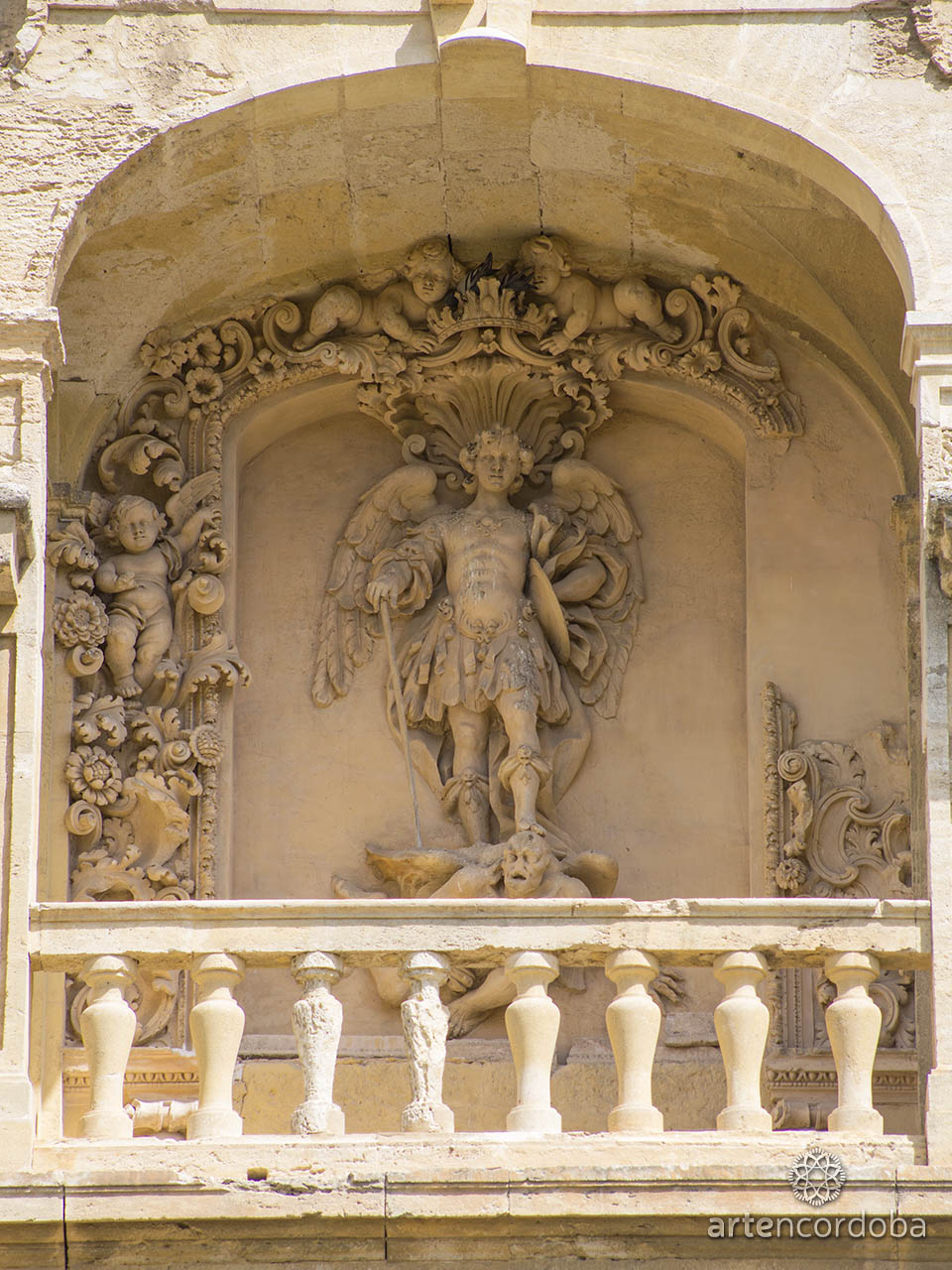
The Bell Tower of the Mosque-Cathedral is crowned by a statue of Saint Raphael.
Completion of the works in the 17th century
Until 1616, when Juan Sequero de Matilla took over the direction of the works, there is no record of any activity on the tower. Bishop Fray Diego de Mardones commissioned him to finish what the previous master could not—the clock chamber. All scholars agree that he followed the plans of Hernán Ruiz III, that is, a tower crowned by a well-crafted brick lantern covered with a hemispherical dome and topped with orbs.
A year later, in 1617, the work was completed.
Subsequent repairs and alterations
Curiously, by the mid-17th century, barely 30 years later, the Bell Tower was in a state of imminent ruin. In fact, the master Sebastián Vidal submitted the following request to the chapter: the tower showed signs of distress and the master builder had submitted a petition… reporting the urgent need for repairs…
The chapter then decided to address the damage, hiring Gaspar de la Peña, who at the time was master builder of the Crown’s works. Under his direction, the South and West sides of the tower were reinforced, and the original minaret doors were sealed. On the East side, a different solution was chosen to preserve the Puerta del Perdón as much as possible, building a relieving arch that required modifying the original portico.
In 1664, Gaspar de la Peña added a new lantern to the bell chamber, on top of which a statue of Saint Raphael was placed, made by sculptors Pedro de la Paz and Bernabé Gómez del Río.
18th-century damage and restoration
In 1727, a storm caused severe damage to the Bell Tower, including the destruction of the pedestal of Saint Raphael. A few years later, the famous 1755 Lisbon earthquake violently shook the structure, causing the collapse of many parts, especially decorative elements. The restoration was carried out by the Frenchman Baltasar Dreveton, and the work lasted eight years.
Visit the Bell Tower
If you’re not sure what to do in Córdoba, we recommend visiting the Mosque-Cathedral by booking one of our guided tours. There, we will dedicate a special section to the Bell Tower. Choose high-quality tourism with qualified personnel—don’t hesitate, ArtenCórdoba is the best option.
Text: J.A.S.C.